Showing posts with label Bosnia and Herzegovina. Show all posts

18 June 2023

Srebenica

We coupled the first two days of the Bosnia Memorialising Conflict trip with a third day of long bus journeys to Srebenica, three hours from Sarajevo. The winding journey took us through some stunning scenery that was the backdrop to the war from 1992-1995. 

Our first stop took us to the Srebenica Memorial Centre, housed in a former battery factory turned UN Dutch Peacekeeping site. The center has been thoughtfully turned into a memorial of the events leading up to the genocide that saw at least 8372 Bosniak men and boys killed, women and girls raped and thousands displaced, at the hands of Rakto Mladic and the Bosnian Serbia forces. 
The memorial spans two floors, covering the people, stories and aftermath of the events. In one room, we watched the footage from Mladic's trial at the ICC in the Hague in 2017 before taking a seat to hear Hasan Hasanovic speak. His gave his testimony to the genocide he witnessed, to the deaths of his loved ones. We hadn't anticipated this, nor had we prepared our students. And there are no words to do his pain, his memories justice. We spent much of the rest of the afternoon silently processing, wondering how humans have let this happen over and over again. 
A few hundred meters down the road, the Memorial cemetery is a final resting place for the many thousands killed. According to our tour guide, Elvis, a young Bosnian who was born just after the war ended, human remains are still being found to this day--some through anonymous tips, others through excavation and building projects. 
We walked around in silence for a bit longer, trying to understand the scale of the suffering.

Sometimes nothing makes sense. But it felt important to bear witness to these dark days and these innocent people. Hasanovic made that clear, that we must pass this message on. Because even in the most remote parts of the world, injustice takes some very typical forms, and we must learn or we'll be damned to repeat history.

16 June 2023

A Bosnian Reunion Tour

Pardon me, it's been an unrelenting school year and burnout lurks just off stage right. Perhaps that makes the timing of a school trip to Bosnia and Croatia perfect (or perfectly mad, depending on how you swing it). 

I won't bore you with the details of quite possibly the third most challenging year of my career. But I will say that this trip looked a lot better from the vantage point of September when I signed up than it did as I rolled out of bed at 3am to head to the airport on Sunday morning. Alas. 

The trip, a four-day jaunt via flight and coach with 53, 15-year-olds in tow, promised to be a bit of a reunion tour of Jen and my trip to this beautiful part of the world in 2010. The lens of this visit is through one of 'memorialising conflict' and we've taken a whistle stop tour from Dubrovnik to Mostar and Sarajevo and to Jablanica and Srebenica and back. This has meant long days travelling through beautiful sceneries, past war-pockmarked buildings; time has not been a commodity here. 

Some things have changed: buildings have been updated; people feel more prepared to openly wear their religion; work has paid for me to stay in my own room in a hotel. There's big perks to travelling as a real life adult. 

And, charmingly, some things have stayed the same: 'vegetarian' food; old men drinking coffee in town squares; the kindness of the people we've encountered. 

Mostar 
After a journey from Dubrovnik and crossing a border with a gaggle of students in tow, we spent roughly 16-hours in Mostar. This largely involved sleeping but we squeaked out a walking tour by foot. 
The perhaps only real benefit of travelling for work, besides not paying for accommodation, is that the tours you'd normally shun are all part of the process. 
And so we shuffled along being told about Bosnia's scars, resurrection and return to new normal. 
In Mostar, that happens to be quite stunning. 

Jablanica 
The next morning, we set off roughly 45 minutes down the road to the town of Jablanica. At the memorial museum there, we learned all about the 1943 WWII Battle on the Neretva River, arguably one of the 'most humane' battles of the war. 
This involved Yugoslav partisans blowing up a bridge to fend off the coming German forces. The bridge, or an approximate replica, exists to this day. The events were also memorialised in a 1969 film, which Picasso created both a painting and artwork for. 
Next stop, Sarajevo 
One completed museum visit later, we rolled into the outskirts of Sarajevo, a breathtakingly underrated city in my humble opinion. To really understand the scope of the Bosnian War and the siege of Sarajevo that lasted from April 1992 to February 1996, we started on the outskirts of the airport. There, we visited the Sarajevo Tunnel Museum, a memorial to the tunnel that Bosnian forces dug under the airport runway and into the city itself. It became a conduit for food, supplies and humanitarian aid during Europe's longest siege. 

A small piece of the tunnel exists today and the museum's owners, a local family, hope that the tunnel's preservation reminds everyone of humanity's simultaneous worst and most hopeful moments. 
Onward to Sarajevo! The city itself has been witness to so many moments in history: from the foundations of the Ottoman Empire; to the assassination of Archduke Ferdinand that sparked the start of WWI; the Winter Olympics of 1984; and the siege that brought the city to its knees. 
And walking around, all of these things become clear. 
Unfortunately, my afternoon in the city was cut short when a student got sick. I got sent back to the hotel to let her rest and to prepare for the arrival of the hordes later. Despite my disappointment, there was a silver lining. Directly next to our slightly-out-of-town hotel was a gem of midwest days of past. 
Be still my midwest at heart soul! 

22 September 2010

Sarajevo (the rest)

so long time, no blog. I'm prepping for yet another exciting journey in a few weeks (Krakow, Poland!) so I need to get on the ball with the rest of my summer (and my half-term french travels in May). I had this brief and fleeting thought about how much money I might have if i chose not to travel. It'd probably be a lot. Then again, I might just have more shoes. And then, instead of being just boring, i'd be really boring with good shoes, and no one wants that.

Anyhoo, here's the rest of Sarajevo. I wish we would've stayed longer, possibly cutting out the Belgradian portion of our journey. But as I've left the blogging of the trip far too long, I'm relying on scant journal notes to relive funnier moments of the trip. Seeing as I couldn't find a journal until Belgrade, it's proving rather difficult to remember anything. Maybe I should stop drinking the cough syrup straight from the bottle and stick to the recommended dose.


the entrance to Begova dzamija (Bey's mosque), central Sarajevo's biggest mosque


fortunately i left my machine gun at home


Across the Latin Bridge, where Archduke Franz Ferdinand was killed, sparking the start of WWI


keeping with tradition, Jen and I frequented 'Hacienda Cantina Mexicana' for the most unauthentic margaritas we've ever had. Which is, of course, part of the fun.


in the maze of pedestrianised streets peddling copper wares, smelly foods and tea


more market


Sebilj, a Turkish style fountain in the middle of 'Pigeon Square'. Suffice to say, we did not spend a whole lot of time anywhere near this place

we had a bit more luck with dinner this time and took Lonely Planet's dining recommedations. The vegetable platter was adorned in actual grilled vegetables, but we unfortunately ran into another issue:


i will have to disagree with this opinion, disguised as a fact.

So, other than the people, the place, the spirit, what did i love about Sarajevo? Ya no se. But I did. It felt like somewhere you could sit, be a fly on the wall and come out with three-hundred interesting observations. I loved the mix of religions, though jen and i had differing opinions on the sound of the call to prayer piped through the city five times a day--me: haunting, her: transfixing. Maybe it also had something to do with the eerily similar to British weather we had during our stay in the city. Is it possible to become used to rain, mist and fog?

We ended it all with a 5am taxi ride to the bus station, followed by an eight-hour bus ride snaking our way through the city's crammed cemetaries, monuments and post-war construction then out onto the open road of rocky precipes, deep valleys and blue, blue lakes. To make the experience truly authentic, we had a Bosnian rest stop, complete with toilets that one must strategically suss out before making a move:


Onto Serbia!

5 September 2010

Sarajevo (mini history and first glimpses)

Following an eight-hour bus ride from Mostar, Jen and I arrived at a rather rundown bus/train stop on the derelict outskirts of a city that seemed twenty years behind the rest of the world i've known. Shoeless Roma children accosted us for money, and I felt very out of my depth. But we carried on...because at first glimpse, outer Saraevjo is rather sad--The Holiday Inn right next to the station stands as a monument of the war. It forms the outer curtain of something called 'Sniper Alley', where Serbian snipers incited terror upon the city's denizens for the best part of three years. Nearly 10,000 people were killed or went missing during this time.


In its history, the Sarajevo Holiday Inn also became the home for all foreign journalists and war correspondents from 1992-1995. It was the only working hotel in the city.

Similar to Mostar, the remnants of war were very visible--from pockmarked, shelled buildings to the deliberately bombed Bosnian National Library to the Sarajevo Roses.

A Sarajevo rose - the characteristic pattern of a mortar impact on pavement. Whenever a mortar killed more than three people the scar that the mortar shell left of the ground was filled in with red paint. These scars look like roses, thus the name. The main pedestrian shopping street in town was dotted with these up and down the boulevard.

From a less than auspicious start, we were directed to the tram and its tricky ticket system. If you've never made your way into a city blithely unaware of where you're headed or where you might sleep, let me recommend it to you now. The best adventures start here.

Straight off the tram we made friends with a rather dodgy looking local who offered us accomodation in his friend's private home located 15 minutes up a hill and next to one of the city's smaller mosques. Apparently the backpacks, hats and squinty eyes gave us away as tourists. We were greeted with sludgy cups of Bosnian coffee, a man who communicated with us in broken German and his daughter who spoke English. It was all rather confusing, but i'm still alive to tell the tale so nothing went too wrong.

When Jen was here five years ago, she was greeted by UN Peacekeepers guarding this cathedral:

and jobless, war-scarred men drinking tea near the monument dubbed 'Pigeon Square'. So today, despite any inward bitterness, Sarajevo has moved on, picked itself up and become what I imagine it was well before the war. Host of the 1986 Winter Olympics; haven to a thriving cafe culture and tourist industry; my favourite place in the Balkans; home.

more editing to come...


with the increase of altitude, the weather took a dip for the lower and we wore jumpers for the first (and only) time over the course of four weeks


Trg Oslobodenja, where everyone's an expert. I almost got caught in the fray of old, loud, shouty Bosnian men screaming to the players something that i translated in my head as 'don't move that piece, you stupid oaf, he'll put you in check mate in two moves!'

30 August 2010

Mostar

Jen helped me kick off my month-long summer travels on the 1st of August when we headed to Bosnia, Serbia and Montenegro via Zadar, Croatia. Our ten-day jaunt through the Balkans left very little to be desired; I'm officially in love with the region. Mostly Bosnia and Croatia, but I didn't get too far into Serbia to get a lasting impression.

Upon arrival in Zadar, we got picked up by a rather nice family who opened up their apartment to us for the small price of 120KN (£14, roughly). As is trusting area practise, we found accomodation coming off the airport bus. A rather nice man called Josip asked us if we needed a room, we negotiated the price and then hopped into his 1996 fiat, or something like that. It would never work in London, New York or the likes of the rest of the Western World, but somehow in Croatia, all is well.

After a night in Zadar with its lovely, lovely sea organ and pasta with prawns drenched in butter, we made our way to Mostar, Bosnia. On the map the two places look around roughly three inches away from one another. In real time, the bus journey took us roughly eight hours, including one three-hour stopover in Split, one dodgy rest stop and one change in currency (this proved problematic).

We arrived in Mostar around 10pm, struggled to find a place to sleep and then wandered into the Old Town, which all slants down or up depending on the way you walk. We met/stayed with a Canadian woman travelling solo and struggled to find veggie friendly food before I duked it out with HSBC for 25 minutes (and £72 worth of an international phone bill). In the end, they decided to let me take money out of my bank account, and the trip continued in all its splendour.

I left my heart in Bosnia for so many reasons that I'm not sure if I can quite put it into words. I had no expectations, which was probably part of it. The food definitely wasn't a highlight--i wasn't a fan of piled high cabbage masked as a 'Bosnian Salad' or deep fried vegetables with a side of fries, the highly recommended 'Vegetarian Platter'. But the confluence of eastern and western cultures and the pride and kindness of the people we met took me a long way.

In my naive little mind I still struggle to understand the sometimes cruel reality of human nature. The battle scars of war stood as bleak reminders of this all across the city, and the entire nation. My memory of the Bosnian War is limited to scant news reports and stories told by former students. But still, i guess i thought war happened in a vacuum devoid of regular civilians. I was therefore repeatedly humbled by the persistence of human nature.
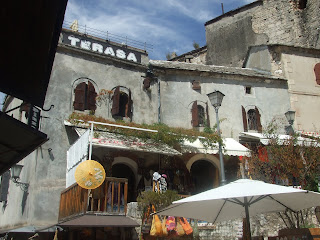


on the streets of the old town


The City's biggest mosque and home to a sad graveyard, the resting place of hundreds of men who died during the Bosnian war


inside the Koski Mehmed pasa mosque


pretty view. what you cannot see is the pockmarked, shelled buildings, signs mandating 'no entry' with skull and crossbones and derelict outskirts


The Old Bridge (Stari Most)


up the skirt of the Old Bridge

The Old Bridge is actually not that old. It stood for 427 years, until 9 November 1993, when it was destroyed in the Bosnian War. The rebuild took place in 2004.


The Crooked Bridge (old bridge in miniature)


Bosnian Coffee, a local take on Turkish Coffee, and just as delightful


view of the icily cold Neretva River that locals dive into off the Old Bridge


a small reminder of the region's conflict


better than barbed wire?


residents of one of the oldest Turkish style houses in the city

Apologies, I'm feeling rather uninspired at the moment. More about Bosnia in the next entry.