Showing posts with label Cambodia. Show all posts

21 November 2013

Floating Forest and a Village on Stilts

On our final morning in Cambodia, our tuk tuk driver took us out of Siem Reap and down a motorway of sorts.  In a tuk tuk, this was a rather exhilarating experience.  Top tip--keep you mouth closed.  Flies zipping by at top speed hit the back of your throat before you have a chance to react.  

We then reached a nondescript junction and then ventured far along a dirt path, another daunting feat.  We passed Cambodia's 'premier alligator farm' and a petrol station--really a lady selling bottles of petrol out of water bottles in her front garden before reaching our drop off point.  We were then shunted through a 'pay station' and into a boat located on a narrow, narrow canal.  This turned out to be part of the floodplain which, in the rainy season, is completely underwater.  

From there, our boat driver motored us through and around the floating forest.  Not floating at all, just a forest of trees submerged, little broccolis sticking out haphazardly in a sea of sauce.  Our driver knew where every root, rock and branch existed.  
Further on, we passed the community of Cambodians who live in houses on stilts.  I've never quite seen anything like it, particularly when some of the houses had stilts so high the water levels would be unbearable.  


Our driver and little boat dared to take out the merging Tonle Sap river delta and only turned around when he saw me clutch the boat with intense fear.  And thus, our time in Cambodia ended. 

Ta Prohm

To me, Ta Prohm was man's lesson in what happens when you let nature run its course.  It would be an understatement to suggest that massive fig and silk-cotton trees grow from the ruins.  There is literally jungle sprouting and protruding from the beautifully ruined remains of what was Jayavarman VII's first major temple project. Ta Prohm was originally constructed as a Buddhist monastery and was enormously wealthy in its time, boasting of control over 3000 villages, thousands of support staff and vast stores of jewels and gold. 

All this history is helpful to know, but when you're standing there the overriding feeling is one of wonder.  For a few minutes, I stood staring at something I thought was a joke. It looks like a joke, like it couldn't possibly exist.  And then I realised it was the sublime sneaking in again.  

A completely different sense of the sublime than Angkor Wat and one that Hollywood has cashed in on.  But maybe Hollywood has desensitised its audiences using all of those well-crafted sets that are meant to mimic real life.  Because I haven't seen 'Tomb Raider'.  But if I had, I would've thought that the background scenery was something of Hollywood fiction, a beautiful lie.  

But it was no lie.  

 trees growing on top of ancient buildings 
around ancient buildings 

Through ancient buildings 
 
in massive bigger-than-person-sized-roots-and-branches 

and skyward protrusions 

it makes no sense.  

it's magnificent 
 

in every nook and cranny, the trees take over 
 And even without the trees, it's still hard to fathom an age where this beauty could be built 
or carved
 
After roughly seven hours of temple-hopping in the heat and humidity, we couldn't process any more.  We needed time to sit, dissect and consider what we had just seen.  Looking back now, I'm not sure if I'm even putting it into words that do it justice.  I do know however, that it is the single most magnificent site i've ever seen.  Coming from a girl who has struggled to appreciate archaeological sites in the past, this is big.  


Jayavarman VII agrees.  

20 November 2013

Preah Kahn and around

Just past the Terrace of Elephants we found a series of smaller temples and ruined walls that were ripe for exploration.  They were a lot quieter than the bigger sites and yet we still managed to get ourselves right into the centre of a Spanish tour group and then stuck behind a snooty American couple.  We began to get a case of temple overload at this point but we were only halfway through our day's adventures.  We persevered.

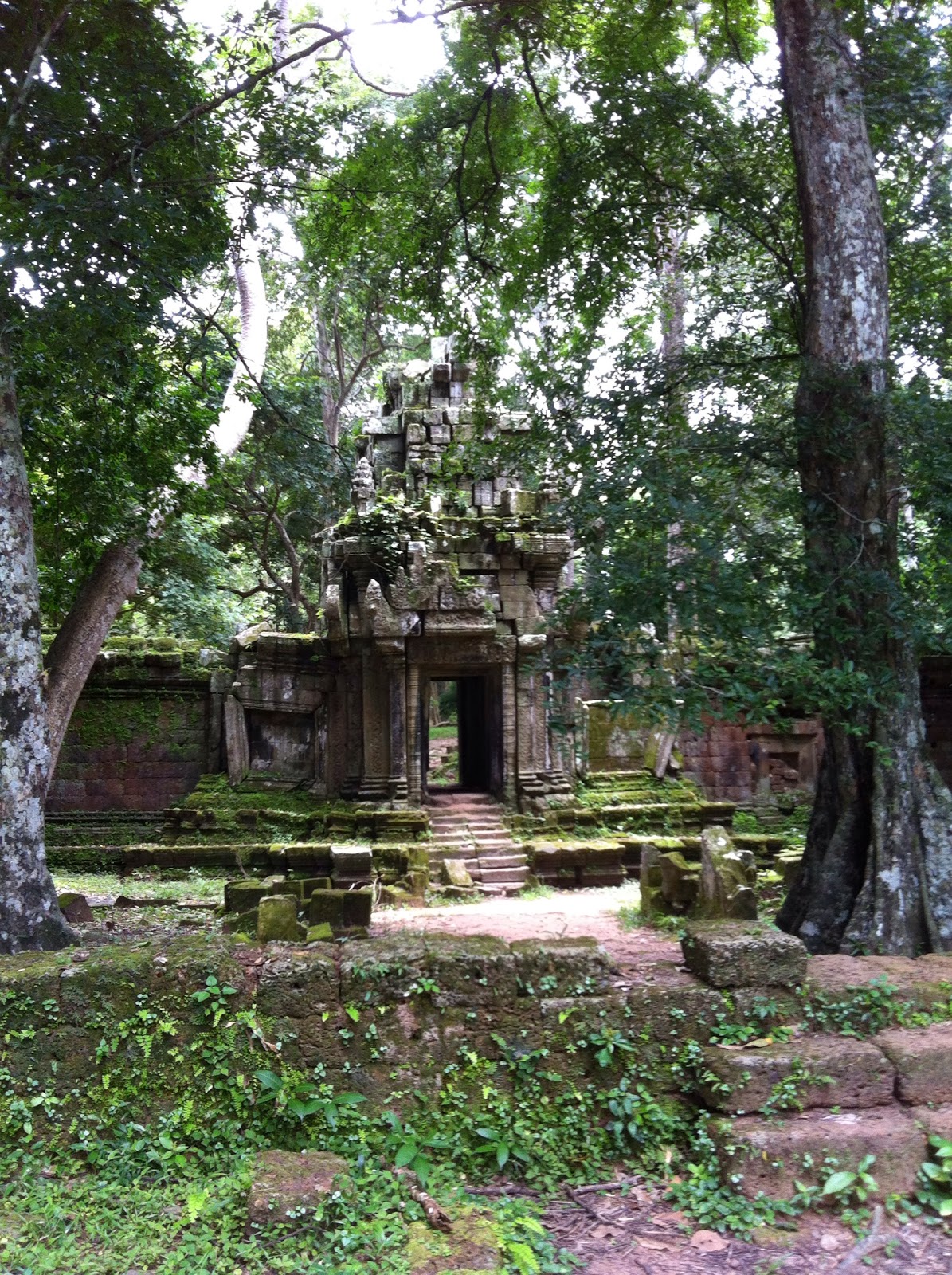
Doorway in the middle of the wild 

Faux terror or just terror?  You can never be sure with Paul

The start of trees reclaiming their surroundings.  Much more of this to come later.


Good to know the 50 foot precipice is safe and protected 


Buddha in the woods

We broke for lunch before making one big temple stop and one small temple stop.  Coming up...Ta Promh, also known as the Tomb Raider Temple.

Angkor Thom

Our next stop took us just around the corner to Angkor Thom, a 3 kilometer walled and moated city-within-a-city that was the last capital of the Angkor empire. Its distinguishing feature was a series of carved faces, said to be those of Jayavarman VII, the paranoid king who wanted to 'watch' his people wherever he was.

In the grand fashion of a megalomaniac, King Jayavarman also ensured that the five gates to the centre of his kingdom were grandly adorned with his face.  One arch in particular leaves you feeling exactly the size of a single snowflake in a massive blizzard.
The approach
intimidation tactics on the approach 

Next Stop: Bayon, the city's biggest temple
Entrance--he's watching you everywhere 


The terrace of the elephants and a whole lot of road traffic

The Angkor Temples--Angkor Wat

As part of my undergraduate studies, I spent a semester at Edinburgh University and took a class that explored the notion of 'the sublime'.  My professors connected it to a series of Victorian novels, landscapes and a general obsession with trying to understand that which could not be defined; I appreciated this nuance but didn't necessarily understand it. Not until Angkor Wat.

The Angkor temples cover nearly 400 square kilometers in Central Cambodia and were created between the 9th and 15th centuries.  There are over 37 temples, some huge, in this space. The site has been capital to the Khmer Empire at several points in history and has survived occupation, civil war and looting at various points in recent history.  

From Siem Reap, our tuk tuk driver picked us up and ferried us to the ticket station--a remote building some 10k away from the entrance.  We paid our one-day $14 fee and were given photo ID cards that we were required to procure at various points in our day.  Most people opt to spend 2-3 days wandering the temples but since time was of the essence, we crammed the 4 biggest temples into one day.  

First Stop Angkor Wat 
Angkor Wat, built between 1113-1150, is the largest temple of the Angkor complex and is considered the world's largest single religious monument.  From a distance it looms impressively and when you get closer it doesn't lose that appeal.  

Despite the 38-degree heat, the temples were teeming with tourists.  We crossed paths with people from all over the globe who followed us from place to place.  Fortunately, we managed to snap a few pictures that didn't show the hordes. 


12th century etchings 
Buddha 
 

 Embracing my inner Asian tourist 
High angle shot 


We spent a solid two and a half hours exploring before catching our tuk tuk to the next temple.  But over and over again, I couldn't shake the sensation of woah.  My brain did not comprehend what I was seeing.  I didn't, I don't understand how something so vast, so intricate could be built in a time before heavy machinery.  To me, Angkor Wat was a testament to the human spirit, an ode to the sublime. 

10 November 2013

Siem Reap

Our photos of the city of Siem Reap essentially involve food only.  There's a very good reason for this--we spent a bulk of our time there at the temples of Angkor Wat for which I've got something like 200 photos of.  But Siem Reap's definitely worth a mention.  

The translation of its name is 'Siam Defeated'; Cambodia's got a sad history particularly in the immediate past.  For centuries, animosity stood between the Siamese and Khmer people.  But during and immediately following the Vietnam War, sides were drawn and divisions were created between Vietnam, China and the US.  A civil war ensued, and the Khmer Rouge regime has now become known to be one of the most brutal in Cambodia's history.

Since these days, Siem Reap and Angkor Wat have bounced back.  Angkor Wat is Cambodia's biggest tourist attraction and more and more budget airlines are bringing their custom to this little nation.  Siem Reap is the feeder town for people to head to the ancient temples of Angkor and it does a good job at feeding, watering and adorning the tourists with various bits of tat and tack.  
the view of a bridge to one of the town's night markets 

There are at least four night markets in a short radius, a loud and brash road of bars, aptly named 'Pub Street' and a range of restaurants.  We found the most authentic looking which was filled with a range of Cambodia and Asian tourists called 'Stephen's BBQ'.  For the sum total of £8 ordered beer and the 'Khmer BBQ Special', a range of small plates of rice, noodles, meat and seafood that came with a tabletop grill.  
After a waiter pours in a small amount of boiling water, the goal is to place the lumpy chunk of lard on the top of the grill and let it lubricate (for lack of a better word) the metal surface.  Then you use chopsticks to place, flip and cook all the ingredients on the grill before placing them into a tiny little bowl and scooping them into your mouth.  

Another variation of this was at 'Master Suki Soup' restaurant where your table is adorned with a built-in electric stove top.  You point to ingredients you want in your soup--I opted for mushrooms, noodles and  morning glory (a vegetable I can assure you), whilst Paul opted for the 'Master Suki Chef Balls' (mostly for comic effect).  The waiter pours in a bunch of broth-like water, you add spices to your taste and then the trays of things and...voila, you have self-service-soup.  

Bless a country that appreciates soup as much as I do. 

Phnom Penh

After sleeping off the jet lag and exploring our first stop, we made arrangements to head to the majestic Angkor Wat in Cambodia via Phnom Penh.  Because I am a glutton for punishment and like arduous bus rides, we booked ourselves into a mini-bus from Ho Chi Minh to Phnom Penh before taking another arduous journey to Siem Reap the next day.  The journey was simple enough to arrange and we paid £10 each for a seat on the 'express' service.  Six hours and a border hop later, we arrived into sweltering Phnom Penh.  

Our first tuk-tuk ride through the city was a little overwhelming...
But we made our way to delightful accommodation recommended to us by Paul's co-worker.  If you find yourself at a loose end in Phnom Penh, may I recommend the Blue Lime?  We paid prices that will disappoint you if you ever try to book a hotel in the US, UK or anywhere else in the world ever again.  Four star accommodation was met with five star service; one of the concierge set us up with a friend of his in Siem Reap who became our tuk-tuk temple driver and tour guide for the following three days. 
 
Unfortunately, because our two-week trip was so quick, Phnom Penh acted a glorified rest-stop.  We couldn't fit in the historical bits we wanted and we couldn't avoid the throng of tourist restaurants, gift shops and other tacky venues.   
 
Fortunately, even in the tourist restaurants you can order a beer for $1.50 and receive a pitcher for exactly the same price. 
 
And we still found a few real gems like this! 
 
The National Museum of Cambodia 
The ascent to Buddha
 
Buddha 
Looking like a real tourist. 

Thus, our day in Phnom Penh ended.  We suited up for our next journey to Siem Reap and loaded our gear into the mini-bus.  We quickly learned that Cambodians use their horns to signal they're pissed off with the way the person in front of them is driving and they are therefore going to pass that person at top speeds on the opposite side of the road despite what oncoming traffic thinks that they're doing there. Amongst drivers that pissed our driver off was an entire convoy of google street map drivers.
If you happen to do a google maps street view search of the route from Phnom Penh to Siem Reap and you see a white van veering from side to side, I'm probably in it.

I think it's justifiable to say that the driving experience was terrifying. But we got to Siem Reap in one piece. And how worth it it was.