2 September 2011

Bullfighting y Tapas

Due to the rain, we had a whole lot of time to discover the best of Sevilla's tapas, wine and cava. On one of our last days we spent the morning dodging the rain in the Plaza de Toros, Seville's bullfighting ring and the afternoon, late afternoon, evening, night eating our way around the city. Spain is having its own moral debate with history and tradition versus animal ethics. I don't feel inclined to weigh in, but I can say that the ring and museum were formidable in size, artifacts and idea.


From there, it may have got a little out of hand and a tad bit messy.
In the Jewish Quarter
our favourite tapas bar, La Gitana

The wine flowed, my Spanish got better and before we knew it we were three bottles in making friends with all the wait staff.


The end of the night is a blur of making friends with an American travelling solo, stumbling down the solemn Holy Thursday streets, getting lost in the same alleys over and over again and eventually making it back to Camas. The headache the next morning coupled with the photographic evidence told us we'd gone out on a high note.
But it was a struggle to enjoy much else for the few hours between checking out of the hotel and our flight.

1 September 2011

Flamenco

La Carboneria is my kind of place. It came highly recommended by my friend and sorority sister Alli as 'the place to watch flamenco'. Plus, it was free. Alli also mentioned it was 'next to impossible to find'. She told us to ask on the street for directions because it was a turn left and a turn right here and then it's just a door, a non-descript door that leads into a cavern of free Flamenco. Sounded enigmatic enough for me.

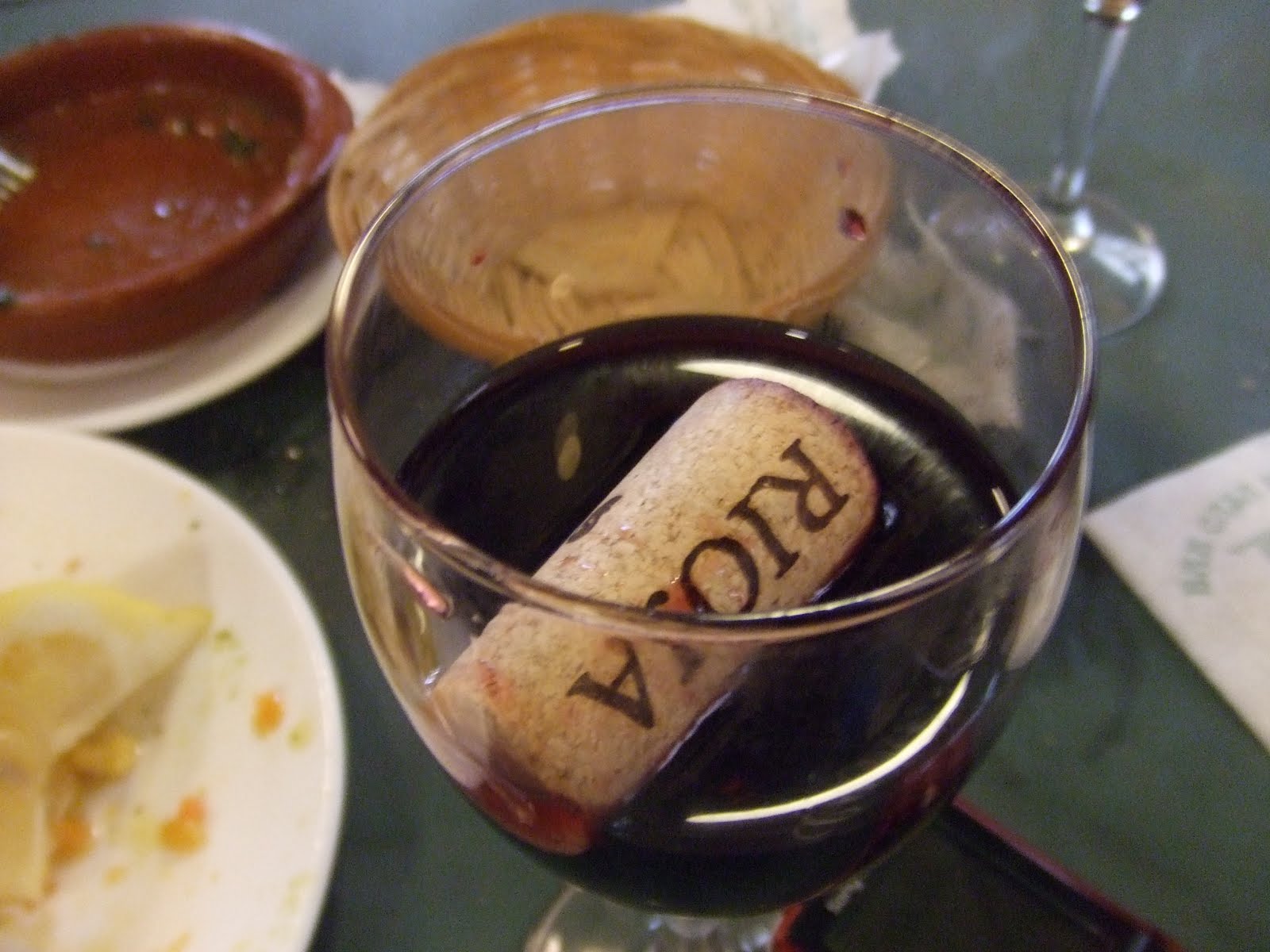
And sure enough, it was next to impossible to find. After one particular Riojafest at our favourite tapas bar, La Gitana (in the Jewish quarter), Rosa and I attempted and failed to find it. We made friends with some waiters who gave us directions and then promptly ditched them. But seriously, this place was a big wooden door in a big stone wall in the middle of a series of other big wooden doors and stone walls.
Inside, there was a maze of tables, artwork and high, high arched ceilings that led into two rooms--one big and one small.


In the front of the big room was a stage, low to the ground and small. We blocked out a seat and made for the sangria until the show started.
Then a large sideburned woman came on stage with her musicians who began clapping in a series of crescendos and decrescendos. I was skeptical until the woman stood up and began to stomp, clap and shake her way across the floor.
And from there I was mesmerised. She was angry, she was sad. And the man began singing his mournful song. He was angry, he was sad. And I fell in love with them all.
After their half hour set, they moved to a stage in the small room where we followed. We took a makeshift seat essentially on the stage, where we got a much closer view of things:

Later in the week, we were persuaded to pay to see a 'Real Flamenco Show' in one of the city's cultural centres. What a shame that was. Compared to our night in the Carboneria, the costumes seemed fake and the dancing seemed lackluster.

31 August 2011

Semana Santa Processions

Semana Santa is decidedly the most austere time to be in Sevilla, as per the Roman Catholic religion mandates. Apparently, though few Spaniards regularly practise their faith, everyone comes out of the woodwork to celebrate the holy week services and attend the religious processions that close off sections of the city at any given time. The pomp and circumstance of the week was sometimes difficult to understand, but I had to appreciate the ritual and tradition attached. On top of that, generations of family seemed to gather together to take part in the week's events.

The processions include marching bands, 'pasos'--wooden or carved sculptures of the events of Jesus's life during the holy week or of the Virgin Mary's grief, and hermandades--religious orders of brothers, carrying long candles and wearing nazarenos, capes with hoods to conceal the wearer's face. The processions start on random streets and end in any one of the city's many churches and cathedrals. The big procession is on Holy Friday and ends in the Cathedral of St. Mary. The week following Semana Santa is the Feria de Abril, the city's biggest festival. It's suposedly the most exciting time to be in the city; the Plaza de Toros opens for the season and everyone celebrates the resurrection of Christ. We left on Holy Saturday so didn't get to partake in the feast, but preparations were well underway all around the city.

Sevilla

For our post-marathon treat, Rosa and I hobbled our way to Seville, Spain, a destination which had been on my top ten places to go list for years. We'd planned it to be there during Semana Santa (Holy Week), which had both its delights and shortcomings. The first major shortcoming happened when we tried to book accommodation. Every hotel was booked, even the expensive ones. This is how we found ourselves in a suburb of Sevilla, called Camas (Beds). Our arrival was filled with pathetic fallacy--the skies tipped down on us as we made it from city bus to bus station having left umbrellas in London. It was late. None of the local bus drivers really knew where our hotel was. One tried, a man named Alonso who we would come to know very well in the coming hours. Rosa spoke her Spanish and he guaranteed that he would stop at our hotel, even though it wasn't on his route. We drove and drove and drove. I saw a sign for what looked like our hotel, but we both shrugged it off because Alonso was taking care of us. Half an hour later, he turned around, bus still careening forward down the road, remembered that he’d forgotten about us and cursed up a Spanish storm. This is the only reason we ended up in a Spanish man's car driving through backwaters of an Andalucian city at midnight. He offered to take us back to his house and feed us bisteca, vino tinto and cerveza. In his own words (and in spanish): 'I am not a pervert, I promise. I'm just trying to make right my mistake. You seem like nice girls and you need to get home safely.' We opted for the McDonald's drive-thru instead. From there, the week turned into a series of wine and tapas crawls, flamenco watching and spot the processions of men, women and children in eerily KKK-style robes. It rained all week so many of the processions were shortened or cancelled. But as the pictures suggest, it was quite a city to sit in and enjoy the scenery, odd people and plentiful rioja.

30 August 2011

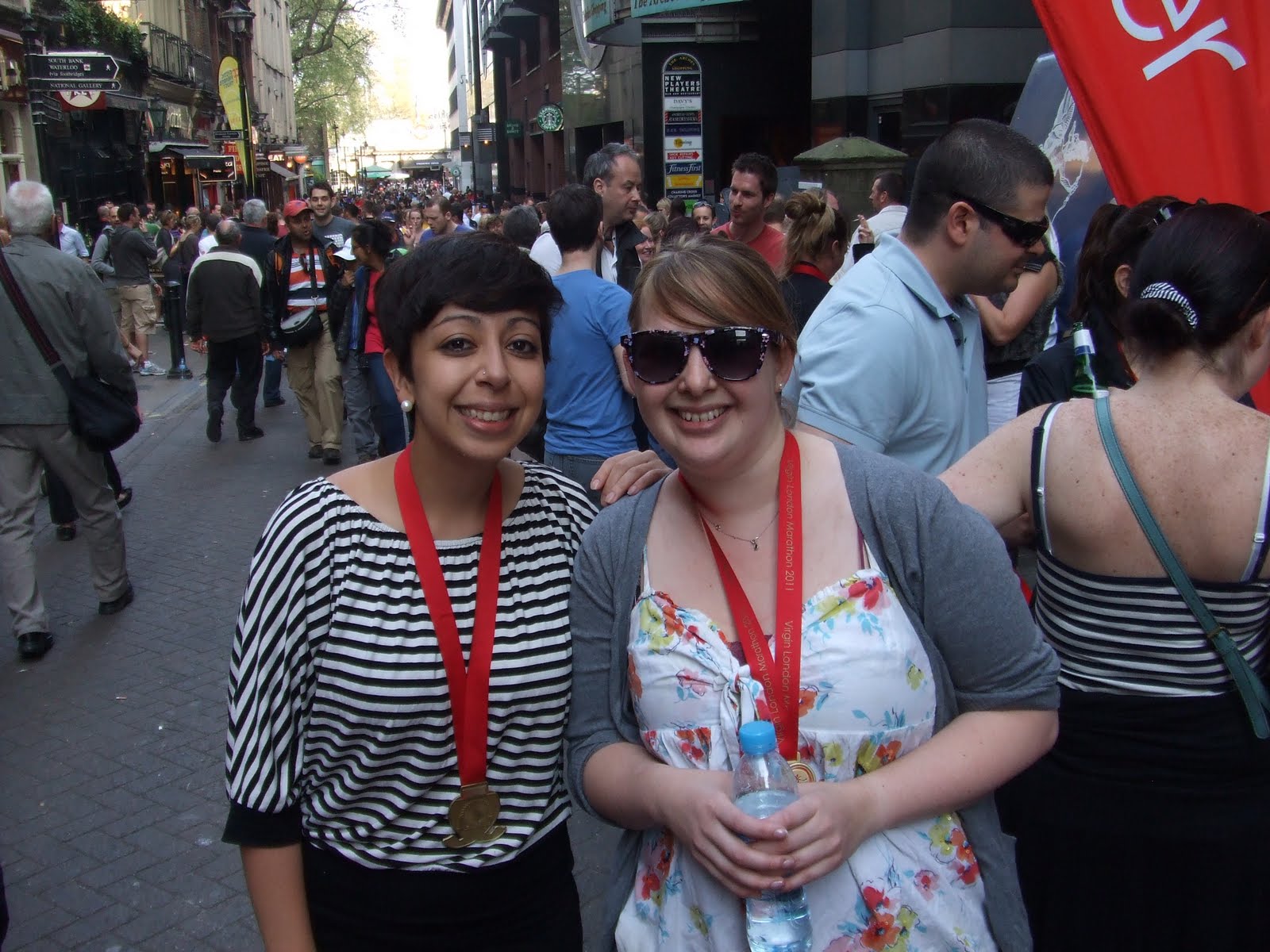
The 2011 London Marathon

Against my better judgment, and my knees, I decided to run the London Marathon.

Rosa and I trained together for the most part. I'd had an amazing 20-miler final long run. I was ready.
oh, and in a tutu.
Rosa, Dawn, Chuck and I met in the wee morning hours of the 17th of April to head down to Greenwich Park. And I thought I had this one, I really did.

After waiting for 27 minutes to let 2/3s of the other 38,000 people running the race start, I crossed the start line with Muse in one ear, Rosa in the other and a veritable feast of bell ringers, beer tipplers, preachers, drummers and drunken supportive idiots cheering along the route.
And life felt good.

Until I crossed Tower Bridge at mile 12 and then it was just metaphorically downhill from there. The day was hot, but no hotter than Edinburgh. The crowd of 10,000 was exhilirating and, unlike edinburgh, I had cheerers in The Isle of Dogs, Canary Wharf, The Strand and the Finish Line. But it didn't seem to matter.

Rosa and I, who'd up to that point had been running together, split off from me and I had a little walk. And then a run. And then a walk. And a run. You get the picture. I met a girl who'd thrown in the towel and chatted with her a bit. I got passed by a man running in a gigantic giraffe costume. I marvelled at how lovely everyone else's charity supported their runners.

I finished the half in 2:17:11, slightly under pace for my desired 4:30:00 finish.

I honestly don't know what happened but my brain refused to send the signals to my feet to just go faster and get it over with. In Edinburgh, I remembered hitting the mile 20 and thinking 'yes, it's only six more miles. you can do this, you can run a 10k'. And then I proceeded to smile, enjoy the end of the race and sprint the last 400 meters.

In London, I hit mile 20 in a fug of exhaustion. All I can remember from then on: running through the showers, which caused me to shiver; smiling wanly at a Charity Girl (not my charity--mine was disappointingly unsupportive) who gave me a Jaffa cake; thanking the darkness of a tunnel out loud; flicking off Paul and Mark while simultaneously screaming at them 'this f***ing sucks! this is s***!'; seeing the 385 yards 'til the finish sign and thinking 'nope, just i'll lie down here' and crossing the finish line in what felt like an hour later. In reality, I crossed the line in 4:54:47, 34 seconds slower than Edinburgh.

There was a dearth of joy.

In fact, the woman at the line who tried to cut the timing chip off my shoe had to move my foot to her. Nothing worked any more. So I rescued my kitbag from the giant trailers located eons away from the finish line and drooped on a curb. I couldn't get up. But a nice binman eventually helped me. Shaking, nauseous and shivering on a 26-degree-celsius day, I thought I was going to faint. And with jammed mobile phone reception to get a hold of my adoring fans to carry me to the victory party, I nearly walked myself to the medical tent.

Alas, I limped my way down to the Embankment. It's amazing what a free shower, massage, dinner and beer(s) will do to transform you:

In the end, I raised over £2400 for charity, which, you know, isn't so bad. But I won't be running another marathon for a long time.

29 August 2011

Pisa, it leans!

On the last day of our mini whirlwind tour of tuscany, Rosa and I took the train back through the region and up to the city of Pisa, known most notably for its tower that leans. or maybe it's more notable for the millions of pictures tacky tourists take (me too, me too!) of themselves 'catching' the 'falling' tower. We had most of the day to burn before a 7pm Ryanair flight and spent most of the time taking stupid pictures, freaking out about the marathon, shopping for shoes and trying to find dinner, which proved far more difficult than we thought.
first glimpses


Other than the tower, Pisa seemed like a city forgotten by time. You could tell that it was one day loved, but between the influx of tourists and immigrants and the collapse of major infrastructural necessities, Pisa was grotty and run down. Lots of smells and rubbish. There were some attempts at regeneration, which it will hopefully receive because Pisa did have its raffish charm. One of our highlights was this super cute cafe:

And of course there was also the three minute ride on the train from the city centre to the airport and the weird Pisan culture phenomenon of free snacks at bars leading up to the dinner rush. It was odd. Restaurants don't serve dinner until like 8. Like none of them. But instead all of the bars opt to serve a high end buffet of starters and hot snacks that rival any Hornsey School parents' evening snack selection. Which, okay honestly doesn't take much, but we're talking bruschetta and fondue and vegetables and pate. You order a drink and you snack for free. These Italians have got something right.

And then we boarded a plane into the future where marathon glory and pain awaited.

28 August 2011

Montepulciano

Other than the food, culture, people, espresso, wine, sun, landscape, etc, i also love the trains in Italy. they are cheap. they are on time. they rock. and trains in tuscany whoosh by to other tuscan regions on a quarter-hourly basis. So we hauled ourselves, walking this time, down to Siena central station and over to Montepulciano, a town I know because it's the home to my all-time-favourite red wine.

After a thirty-minute journey we arrived into Montepulciano central station looking for the city centre. And we wandered. and wandered. and wandered. until it transpired that the station was a neat seven kilometers from the city. so we waited and waited and waited for a bus. but it was worth the wait...
going in...


These buildings may look familiar because, in more recent history, the town was featured in the second 'Twilight' film, 'New Moon'.

we started our tour by devouring beautiful bruschetta
and appreciating red, white and green in various aesthetic forms


everything about this town invited you to stop. sit. drink. eat. stop. sit. i don't know how to more explain it. From all angles you're staring at cobbles or towers or churches or shops tucked into medeival walls. and you feel little. and lucky to have found it.

arrivederci!