27 April 2013

A Tuscan Wine Tour

Spoiler alert: this gets messy.

Because I agreed to accompany Paul to San Siro Stadium, the home of both AC and FC Milan, he agreed to accompany me on a day trip through the wine making parts of Tuscany. Paul is not much of a wine drinker but I happen to be partial to a tipple or three of red. Despite their ubiquitousness with the region, tours of this sort don't come cheap. But we stumped up the roughly £70 each to take part and moved on with our lives. 

The next morning we arrived at the train station, our pickup point, promptly for an all-day festivus only to see no one else loitering. It took us another twenty minutes to twig that perhaps the three near-retirement age couples decked in running trainers (no signs of running qualities in the individuals) and loosely fitting jeans were our fellow participants. It just so transpires that the median age of a tourist in Tuscany over the Easter holidays is roughly 65. And American.

Our not-nearly-geriatric tour group consisted of two retired teachers, a doctor and his wife and a couple who were doing the tour circuit again and again--they'd been on this same wine tour twice already in the last month.  They hailed from Chicago, Oklahoma, Maryland and were charmed that we were young and traveling. In the first twenty minutes, we became everyone's adopted children. They wanted to know where we were from, how we met, when we were getting married.  They probed. We laughed. 

First Stop: Vinci 

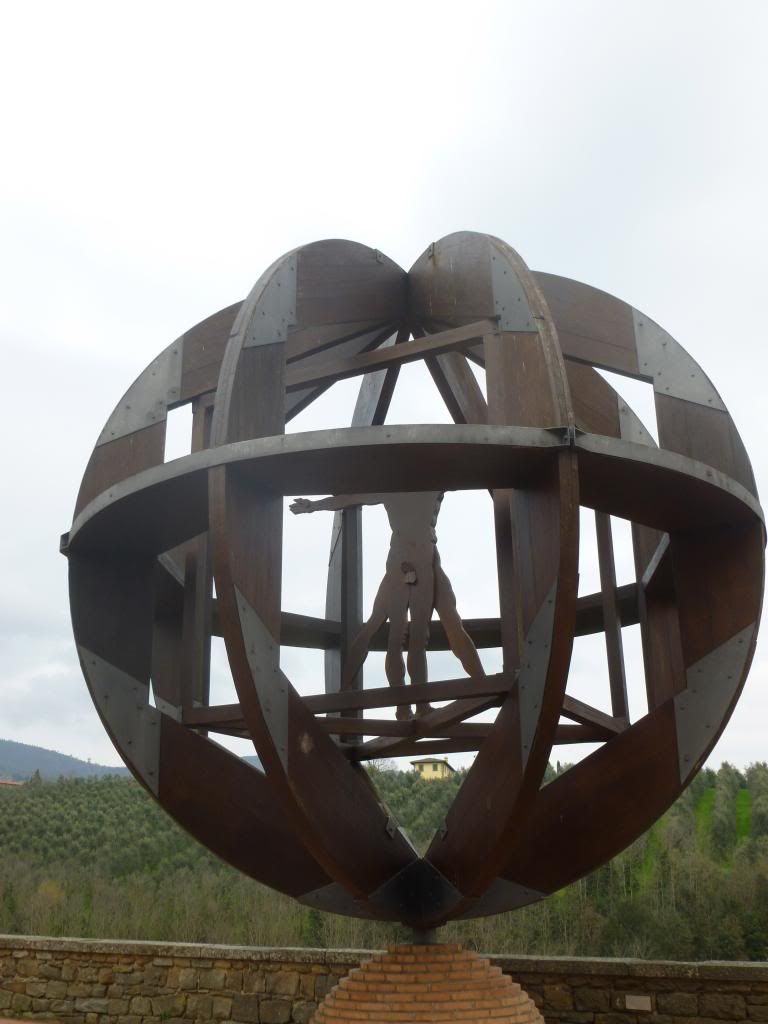
As can probably be deduced from the name, Vinci is the home of the famous Leonardo da Vinci.  It was a small town tucked into the Tuscan foothills--verdant valleys lay in every direction and included the hill where da Vinci tried and failed at creating a flying contraption.

Today the town is an homage to all things Leonardo:
The church where little Leo was baptised 
Second Stop: Wine! 
From there, we made our way to a tiny winery even further into the windy roads of Tuscany.  We arrived at a nondescript farmhouse to be greeted by a woman who'd been in the business for quite some time.  
She showed us around the barrels, the process and the refinery itself before leading us to a large rectangular table that housed breads, meats, olives and oil.  

And then the drinking began. First wine. Then proprietors led us to a beautifully adorned table and fed us olive oil, bread and charcuterie. 
We got into an extensive conversation about where we were from and how we all came to be here in this moment. Dr Ralph's wife mentioned Oklahoma, I asked her about any fear of tornados--it's a common association. She burst into a fit of drunken crying. Her brother's house had been one of the many victims of the 2011 Joplin tornado that ripped through the community. As Paul looked at me like some kind of monster, someone passed her another glass of wine commented on the aftermath of kindness and goodness in people and the moment passed. 

And because Paul hates wine, he took to throwing back each bigger-than-a-tasting-size glass back with aplomb.  He treated them like shots--quadruple the regular size shots but shots nonetheless.  The volume in the room rose and we staggered out to be met with grappa which I can only describe as what it must taste like to swallow paint thinner.  My throat and stomach burned for an hour.  

As the wine flowed, our hostess decided to opportunise on the moment by bringing out the goods for sale. This involved lots of conversations on legal allowances, transporting wine in suitcases, brushes with TSA. Our friends bought generously and we opted for some beautiful, beautiful olive oil. 

Sales done, we all bundled into the mini bus for one final journey home. Paul was given more advice on his need to propose to me and to get the family started. And because it was all with good intention, we laughed along and tucked well-meaning advice to the back of our minds. At the end of the hour-long commute back, our tour guide gave a plug for the other tours their company ran. 

And thus, four hours later, eight adults piss drunk in a mini-bus outside of Lucca agreed on a reunion tour to Cinque Terre the next day.

26 April 2013

Salute to the Coffee Nation

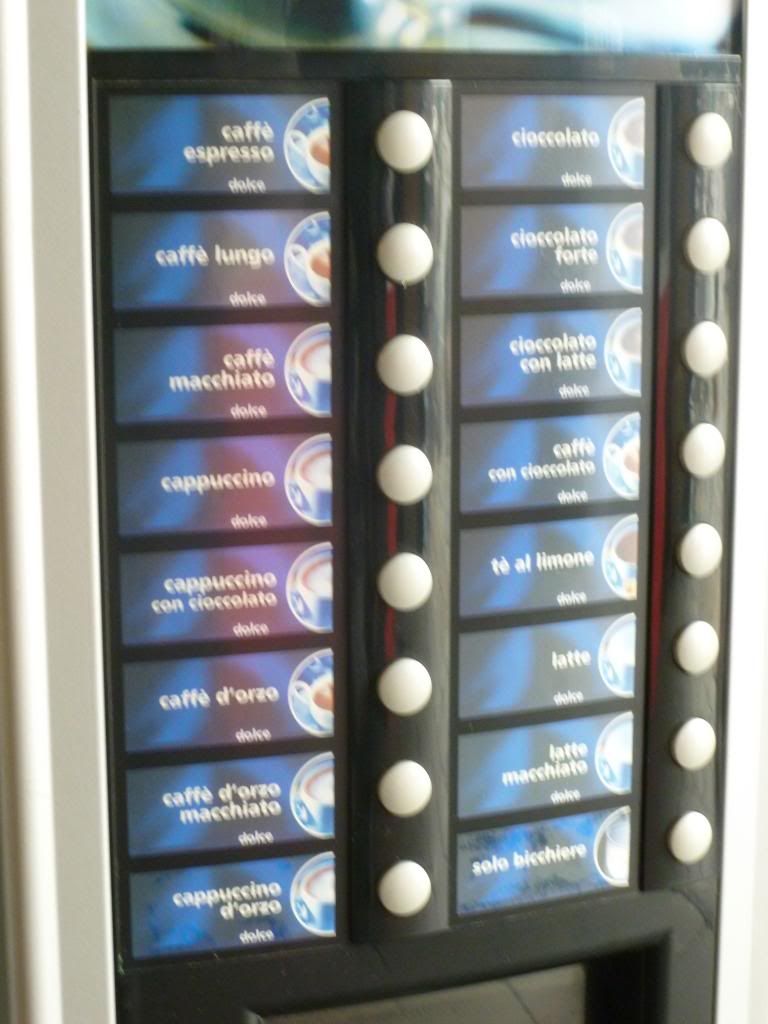
Never has a country more revered the dark caffeinated liquid that millions of people bow to every morning.  From walk up standing espresso bars to the humble train station vending machine, I must argue that Italians absolutely know wheat they're doing when it comes to addictive beverages.  And there's an addiction for everyone. 
Coffee's embedded into the culture--old men, young men, groups of women cluster in piazzas, sipping their mini-mugs in Armani sunglasses looking ever so effortless.  

It's the British equivalent of pub culture.  Americans take it to a different extreme--big cups in air conditioned cafes.  But essentially the root of all this sit-back-and-relax must have started in one square or another in this ancient Italian nation.  


23 April 2013

Lucca, Toscana

Tuscany has my heart although I imagine that everyone who makes their way to Lucca probably feels this way. It's one part medieval mecca, another part culinary delight. Throw in ample opportunities to sit in a piazza in April and sun yourself and you just can't lose. 

We made our way to the tiny but charming B&B La Romea and were greeted with an ancient property updated into five-bedrooms of very affordable bliss smack in the middle of the city. The owners, Gaia and Guilio, were helpful in responding to our questions and offering advice about our home away from home. Later in the week we caught Giulio having a little passeggiata, snacking on bread he pulled out of a pocket and smiling to himself as he strolled. Thus, despite Lucca being very much on the tourist trail, a whole host of locals love this little city as much as we did. 

The narrow streets of the city leave it to be best explored on foot. The daytime saw lots of day trippers head into the city only to leave on their way to Pisa, San Gimignano or other wine-able towns further afield. Sunday is a day of rest in Italy and so most things were closed; even the day trippers stayed away and we got to enjoy a true pause in our busy travels.
Tucked away from the main centre is the Piazza dell'Anfiteatro, a public square built by the Romans in the traditional shape of a Roman amphitheatre (hence the name). The streets surrounding it all slope inwards waiting to reveal the goodness in the middle. 
This was perhaps one of the more touristed parts of the city and so we ambled through, took some photos and made our way to less frequented parts of the city. 
Smack on the opposite side of town, a fairly short walk away, the Duomo di San Martino does its churchy thing. 
We happened to be in Lucca on the Sunday after Easter, which holds a special reverence for the local people. It's a day where Luccans celebrate their liberation from Pisa, an event that dates back to 1369, way before the Italian state even existed. The emancipation was bloodless and involved large sums of money changing hands. But the locals celebrate with lots of drums, flags and fabulous costumes. 
From here, the central piazza is a short wander away. San Michele in Foro lies smack in the middle and we sat and watched a host of student musicians busk their way around the square. 
The further afield you head, the wider the streets become and the more the trees peek through. April really is a beautiful time to be here.
Cycling the City Walls 
The town of Lucca is surrounded by renaissance-era walls, built as defensive ramparts, that, over the years everyone thought were a good idea to keep. We approved. The walls take you 4.2km (the second longest city walls in Europe, next to Nicosia in Cyprus) around the city and offer expansive views of the Tuscan hills on one side and the ancient city on the other. Hiring a bike is cheap and there are plenty of businesses that will happily help you part with your money. Once on the walls there's plenty of space to ride at your own pace, stop for a viewpoint, picnic, coffee or gelato. 
Food 
And because all that cycling will make a person hungry, we made our way to one of the many outdoor tables back in Lucca proper. Pizza, pasta, prosciutto, whatever takes your fancy is most findable here.
What's not to love? 

Genoa

Genoa is the place you visit when you're sick of tourists. When you want to see how Italy really works. When you want legit gelato, legit hole-in-the-wall sandwich shops. When you want to stay in a former palazzo turned B&B for cut rate prices.

And so we started our journey of the Boot in this very working port city bordering the Ligurian Sea. We'd later go on to visit some of the tourist big hitters like Tuscany, Cinque Terre and Milan. And they're magnificent, don't get me wrong. But Genoa holds no expectations and that made it all the more interesting. 

Because just about everywhere in Italy is packed with history, we weren't surprised to find out that Italy's sixth largest city used to be home to one of the most thriving ports in the country. By used to I mean like for seven centuries. And with that, came money, power and beautiful architecture all around. 
Which is how we got to stay in the beautiful B&B Domitilla, up a series of a hundred stairs (or a journey on the city's funicular). The location in a converted palazzo offers a vantage point of the harbour and there's a stunning communal terrace to sun yourself if that's your thing. 
Our only drama lay in finding the place. The directions, translated into English on the website, told us that, from the bus station, we needed to turn right at the semaphore. Paul wracked his brain; his Italian hadn't covered this term. This was pre-the days of free mobile data in Europe and Googling wasn't an option. And so we circled and circled and Paul continued to scan the Italian archives. Twenty minutes later, his Teach Me 1000 Words of Italian lessons with his dad came through. Semaphore=traffic light. 

Fortunately, that was our biggest drama of our trip. Our three days here consisted of pottering around the old town, another UNESCO listed site, taking a trip to the aquarium and wandering the Porto Antico, a harbour re-invented for evening passeggiatas.
In the old town, there's most definitely a faded glamour. The streets feel like they need a bit of love but people are still very much living their lives outdoors. Genoa is experiencing a crisis much like the smaller towns of Italy; there's a rapidly ageing population and young people tend to move away to the bigger cities where more jobs exist. Birth rate is declining and there's not a huge pull for young people to stay. 

Pink flamingo graffiti dotted the city and although we couldn't quite get to the bottom of it, we were fairly convinced it had something to do with prostitution. Try searching that on the internet though...
I'm aware that I haven't painted a particularly rosy picture of Genoa but we did really enjoy our time there. My camera wasn't able to capture the nuances of sitting in a piazza at lunchtime and watching workers stream out of their office buildings and into the holes in the wall that were actually elaborate delis. The sandwiches were epic--all kinds of meat and bread and cheese in colourful combinations appeared from every corner of the town centre. Gelato, likewise (and covered in an entry entirely of its own). And people stopped and took the time to pause and meet friends for a chat, even in the pouring rain. 

As for us, we continued to explore, finding gems of working city life. 
And to us, that was in no way disappointing. Although I couldn't name the various tourist sites and destinations because we didn't even scratch the surface, Genoa is definitely worth a visit. 

22 April 2013

Italia

Prosciutto. Gelato. Vino.  What else does anyone need to know about a holiday to Italy? And now, two weeks on, with daily sessions pounding the pavement of Islington, my jeans just about fit again. Because when you're in Genoa, the home of pesto and focaccia, Lucca, the home of truffles and Tuscan wine and Milan, the home of pizza slices bigger than your head, no eludes your vocabulary.

As always, I'm underwhelmed by blogger and google's stinginess in photo space. Because it means I have to follow a process of uploading pictures onto a third party vendor, attaching the links and crossing my fingers.  This process takes time.  I have also moved flats and currently come to the world wide web via a dongle.  Which isn't nearly as lewd as it sounds.  But this does mean it restricts bandwidth and all these other technological processes I know little about.

Alas.

Our Trip to the Northern region of the boot:
**Four days in Genoa includes a wander to the richie rich Portofino, Santa Margherita seaside towns
**Four days in Lucca, Tuscany including a wine tasting tour with six geriatric americans, one of whom I made cry, in the Chianti region
**One day trip to the Cinque Terre National Park which felt a lot like Disneyland, only more beautiful and with 10 times the number of tourists
**Two days in Milan including a tour of the fusilli-shaped San Siro Stadium, home to both Inter and AC Milan FCs (Paul's choice, not mine)

One day, probably when exam season is over and i'm not leaving work only to come home and do more work, I will expound on these events.  Mostly relaxy sit-in-bars-and-watch-the-world-go type posts, except for the crying american woman, of course.  That day is likely to take shape in June, during half term.  I am going to try something new and stay in London for once.  And then I shall blog all the spaces in between.

So get ready. We're going to Belgium and Turkey and Thailand and Spain and, and, and in a series of discontinuous narratives.

16 March 2013

Making Peace with Coventry

My hate affair with the West Midlands began one non-assuming day in February of the early Noughties   when my then-boyfriend decided to do a PhD at Warwick University and live in the back end of nowhere. Tile Hill, Coventry to be more precise.

Very few people will go knocking down my door in protest--Coventry is a city bereft of charm.  It's a constant reminder of the 1950s post-war rebuilding project. Concrete block after concrete block surround a roundabout in the flat slab of ruin that remains.  There are shops and everything, don't get me wrong.  But if you could imagine the worst of what American suburbia meets English weather has to offer, you've got Coventry.

It doesn't help that the university lies neatly between the middle of two nowheres, not quite in Coventry and not quite anywhere else. Royal Leamington Spa, a 25-minute fluorescent pink bus ride away, is its closest smug, wannabe-London cousin and happens to be the home of half the university's student population.  With its cute little high street and 'Royal' status because the queen came to visit some time in the mid-1900s, it thinks itself a little higher than it is.  Leamington had a lot of noses in the air in its short little high street.  A lot of students with a lot of money and a lot of pretensions.

So I guess it comes as no surprise that I hated just about every minute of life in that place.  I started my MA at Warwick, which housed the nation's third best English Programme, feeling very much like a minnow caught in an ocean current being dragged to the ends of the earth.  I was depressed, limiting my activities to eating biscuits, watching Cash in the Attic at precisely 12 noon daily and using reference books to read the myriad indecipherable articles, journals and postcolonial novels my professors threw in my direction. I had few friends, my lecturers were aloof and protective of their research and the closest creature comfort of a city was a £45, 1.5 hour journey on the train.

Almost immediately, and unspectacularly, my no-longer-long-distance relationship began to crumble.  Little things really, but we hung on. The fireworks came later, way later. But first I finished my MA and moved to London for a job.  We stayed together fighting the inevitable.  Going back and forth for the 'distance years' was dreadful--trains from London to Leamington on Friday nights and the reverse on Sunday evenings. Trading off London and Leamington weekends, trying to juggle our differing lifestyles.  It continued on and on and on for two years. And then we broke up.

 Clutching at the pieces of myself that remained, I vowed never to go back.

But three years later, Warwick in Africa happened.  Shakily, shakily I braved the elements.  Carrying the demons along, I boarded a train back to Coventry. Back to Warwick University to interview and then take part in a summer teaching programme in Ghana.  To work with a group of master teachers who would deliver Professional Development Sessions across the African continent.  I will admit, the first three train rides, I shook.  Physically, not metaphorically.  To the point that the people around me looked a bit concerned.  They took other seats.

But here I am again sitting on a train--my sixth or seventh journey back.  I've stayed for the weekend at a friend's house in Leamington.  I survived it.  And I know this sounds dramatic and probably a bit over the top, but it's been a hell of a journey.  I will never love, or like, this place and I will never move here.  But I've finally made Warwick University work for me. I've met inspiring educators and peers whom i've had the privilege of learning from.  I have friends who get it.  They get me. They get education. They get ambition.  I'm networking.  I'm remembering why I'm in education--because that easily gets lost in the bureaucracy of the day-to-day.

It's been my biggest, longest, most arduous journey.  Humbly, I'm grateful.

3 March 2013

Antwerp

If Belgium were a family, Antwerp would be the punk middle child, the one with the purple mohawk and several piercings through both nostrils. It's a bit grungy, a bit rough around the edges, but that makes you want to hang out with it more. You feel almost cool by association.

As we wound our way up the country the weather turned cold and breezy. Considering its place on the sea and its status as a major shipping port, I guess we should have expected this. Someone the weather made the option of cozying up in pubs and drinking the local tipple all the more inviting.
The rain kept activities to a minimum but we did manage to also find a street full of graffiti artists, a ton of great shopping and relics of old world Europe.

And lots of random sex shops:
 No Belgian city would be complete without its nod to Tin Tin:
 My memories are otherwise too far removed. But Antwerp's got charm in spades. Go. Drink. Graffit.