20 July 2013

Awaiting Another Adventure

It's just about happened. I've just about survived the 2012-2013 academic year.  As per my self-imposed rules, I've only cried once on the school premises, tried the whole force yourself to leave by 5:30 every day only to abandon it after three days and managed to keep my one-cup-a-day habit in check.  I still don't like tea.  I still take every advantage to eat chocolate biscuits.  I still have those moments where I question, re-question and re-re-question my own sanity.

Alas.

This is the time of year when people ask me how I like my job and I can, hand on my heart, say that I love it.  Six weeks off doesn't hurt.  But in reality, it's more than that too.  I love teaching.  It drives me crazy, it makes me worry, I have sleepless nights.  But I couldn't imagine doing something I'm not passionate about.  How do you fill 40+ hours a week with something that just makes you feel meh? 

But this is not the forum to entertain philosophical thoughts.

Because it's time for another adventure and I'm big on adventures.  So whilst I have three more days of school left, I also prep for Ghana 2.0.  I'll spend another two weeks of summer with the Warwick in Africa Masterclass Teaching Programme.  Two more weeks with a group of nine other teachers as we sashay our way through Accra and into the environs of the Agona Swedru province.  

I didn't need to get any jabs this time around; they're all boosted up.  I'm stoked.  I'm slightly afraid of gigantic African mosquitos and severe heat--the forecast predicts two solid weeks of humidity and thunderstorms.  I'm probably more afraid that I'll have nothing to offer these teachers. But i'm working on that.

And after two weeks in West Africa, I come home to five days in London and a little jaunt across a few time zones to make my way to Cambodia and Vietnam for another two weeks.  I look forward to noodles, tuk tuks, temples and beaches.  I look forward to away.  Away is good. 

I may one day blog all about it.  It'll take me time--I've just about finished journeys from two years ago, only to have not touched most of my travels this year.  But my two summers ago Thailand travel is finally blogged so that's progress.  And going back in time is fun.  

So from my continent to yours, happy summer everyone! 


7 May 2013

Milan

I've saved blogging Milan for quite some time largely because I'm not sure I loved it. This is probably the wrong thing to say but it turns out that when you travel there are places that speak to your soul and places that don't. I should make the disclaimer that the weather was less than ideal and we dodged the rain for much of our stay. I should also note that staying in Bergamo put a damper on how much we did, when we arrived and left town and how much relaxation we could get. So perhaps the smarter thing to say would be that we didn't get the best first impression of Milan but that's entirely not its fault. Ducking Furniture Convention people. 

With really only 1.5 days factoring in a tour of the San Siro and commuting time, we opted for the big hitters of this city of 1.4 million (or 8.2 million factoring in Greater Milan). First stop, the Duomo. As is with every Italian city, large and small, Milan's cathedral is a buzz of tourists, local and otherwise. It only took a cool six centuries to complete and is Italy's largest cathedral (St Peter's Basilica is technically in Vatican City and NOT in Italy). The Duomo has survived Napoleon and WWII, making it a significant backdrop to some crazy moments in history. 
A short walk away, Sforza Castle is similarly impressive. Built by Francesco Sforza, the Duke of Milan, in the 15th century it's a testament to what can be built with cheap labour.  It's been renovated across the centuries and today is home to several museums and art collections. 
From there, we wandered the shopping streets of the world's centre of fashion, noting that the Milanese love their dogs just as much as they love their fashion. Around the Galleria Vittorio Emanuele II, Italy's oldest active shopping mall, shops and antiquity stand side by side and my little American brain continued to grapple with the fact that most of what I was looking at was 300+ years older than the founding of my home country. 
So as I come to my conclusions on our short time in Milan, it's become clear that I'll need to go back. This is hardly a fair representation of Italy's second most populous city, a stronghold of industry, education and the country's thriving youth population. We need to get back--to go to Navigli, to soak up summer sunshine, to see the best of what Milan has to offer. 

6 May 2013

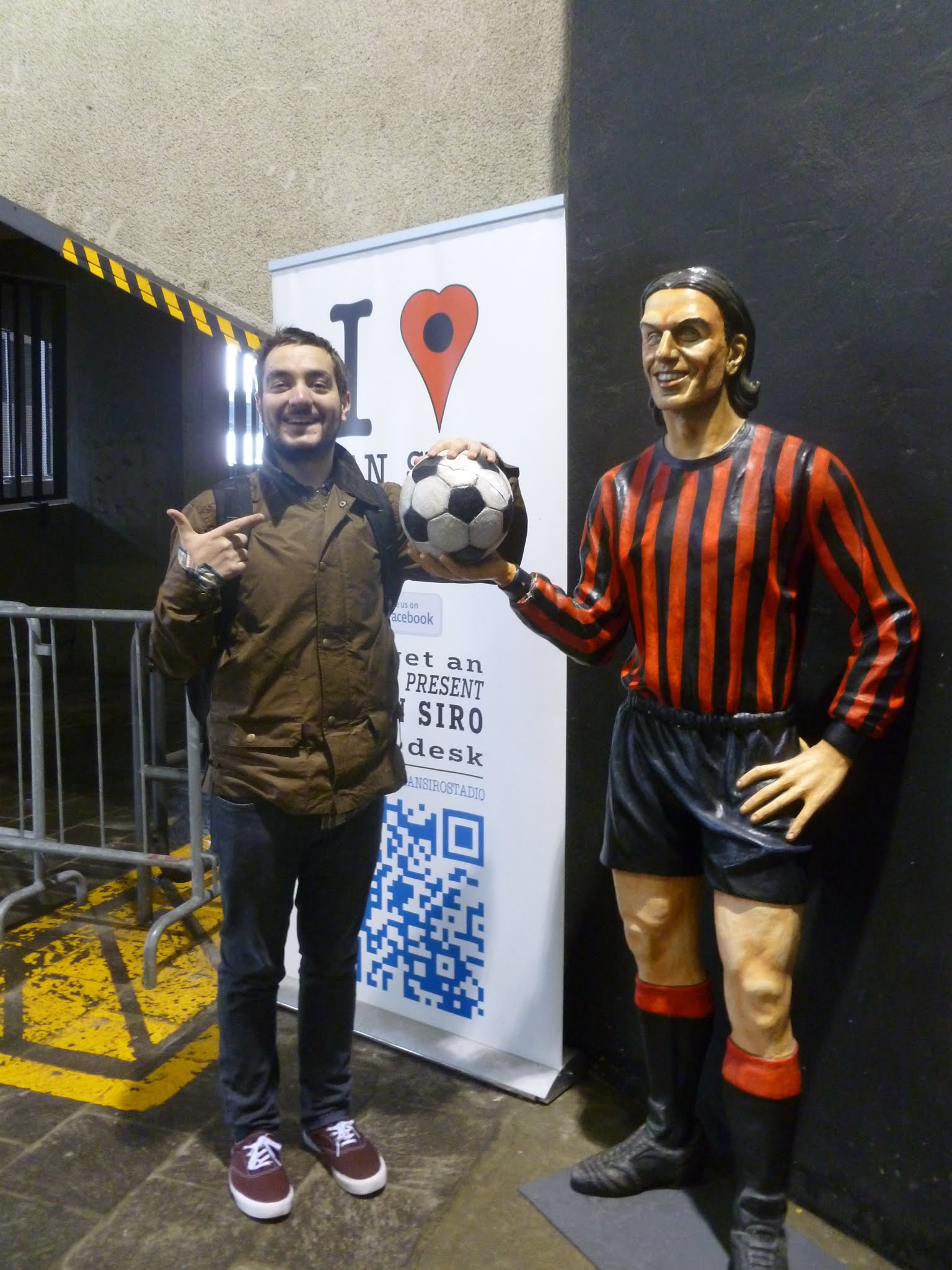
San Siro Stadium, it's shaped like fusilli!

Paul makes few demands regarding our travels; he's generally along for the ride which is both a blessing and a curse. So even though he was annoyed that we were staying so far away from Milan, he couldn't complain because he'd not done the legwork either. But one demand he was keen to make related to his other great love, football. Since he delved into the world of wine tasting with me, I figured a jaunt to Italy's greatest football stadium was a no-brainer.

Home to both AC (owned by former Bunga Bunga prime minister Berlusconi himself) and Inter Milan, the San Siro stadium is Italy's largest (and fourth largest in Europe). It occupies a patch of land 5km northwest of the city centre and seats over 85k people at any one time. Street art litters the hoarding leading to the stadium in an homage to football's greats in their historic (and infamous) moments.
One glimpse at the stadium and Paul was like a kid in a candy shop. 'Jen, the staircase columns are shaped like fusilli, did you know that?!' I may never have seen him as excited on a holiday as this.
The San Siro area of the city (hence the stadium's nickname) is also home to the city's main horse racing venue and was in fact the reason that Piero Pirelli, AC Milan's then-owner, opted to build the stadium here.
Once inside, we joined a lengthy tour, from pitch to locker room to press screening area. I must admit, it was pretty interesting. The stadium's formal name, Stadio Guiseppe Meazza, is named after one of Italian football's greats and is perhaps a good sign of how important football is for the Italian psyche. The city of Milan actually bought the stadium in 1935 and thus, its future is in their hands. 
AC and Inter Milan share the pitch but have separate changing rooms. On match days where they play one another, one team is seen as 'home' and another 'away'--home teams get more fans and so the rivalry continues.
The stadium is also home to two museums, one devoted to each team. Although much of the exhibits were lost on me, Paul seemed to really enjoy himself. 
For 18 Euros, a few hours of football bliss seemed well worth it. If you're not a football fan, there's still plenty to appreciate. Just be mindful to book in advance!

5 May 2013

Bergamo

The last leg of our great Italian journey took us to Milan, home of football's hallowed clubs, AC and Inter Milan. Paul's brother had bought us (okay, him) a stadium tour of the San Siro Stadium and so our pilgrimage began. Unfortunately the rhythms of the Spring term of school for me and Paul's general lack of planning desire meant that neither of us did any preliminary research into accommodation in the area.

And it just so happened that the world was descending on Milan at precisely the same time we'd be there. The National Furniture Trade Show drove hotel prices in the area up to three times more than usual. Nope, not joking. And so the closest town with a vacancy that wouldn't break the bank was a 35-minute train ride away in the rural town of Bergamo.

We opted for a lovely B&B called La Casa di Campagna. The proprietor, a lovely woman who'd converted an old farmhouse and kept horses on the property, picked us up (and later dropped us off) at the train station and drove us into the Italian backcountry. We were situated fairly far out of 'town' proper still and without a car, we resorted to foraging for food on foot.

The Citta Alta (the old walled core) of Bergamo is situated on a hilltop upon ancient Venetian fortifications. The one-hour walk to civilisation proved very hilly and the weather didn't always behave but once we got to the top, the views were pretty rewarding. Upon further research, there does appear to be a funicular that will take you to the top, not that we saw it...
Once up the sizeable hill, a perfectly preserved world awaits. We only went for one evening and most shops, churches and museums were closed by the point we arrived but the town is definitely worth a day trip. Plenty of articles abound on the history and charm Bergamo has to offer, particularly if you're tired of Milan big city living.
We did have a notably fantastic meal at one of the town's several restaurants. Osteria Tre Gobbi boasted good food, plentiful wine and excellent views of Lower Bergamo down below. Happy and full, we trudged back down the side of the hill to our B&B ready to take on Milan in the ensuing days. 

4 May 2013

Gelato Happens

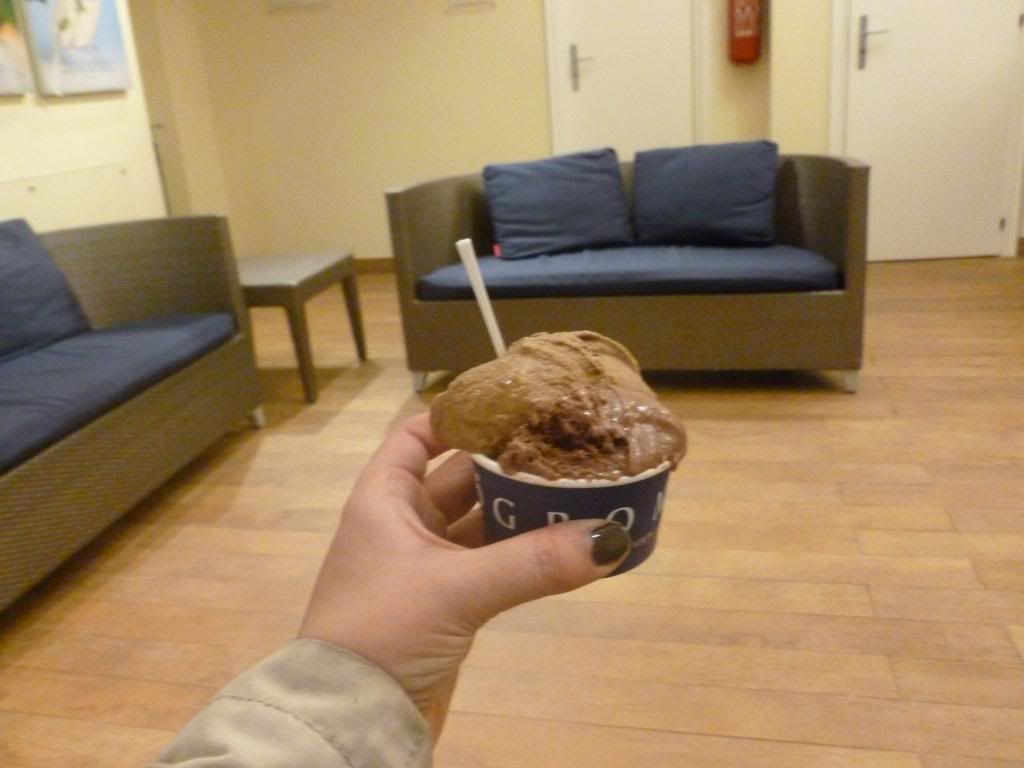
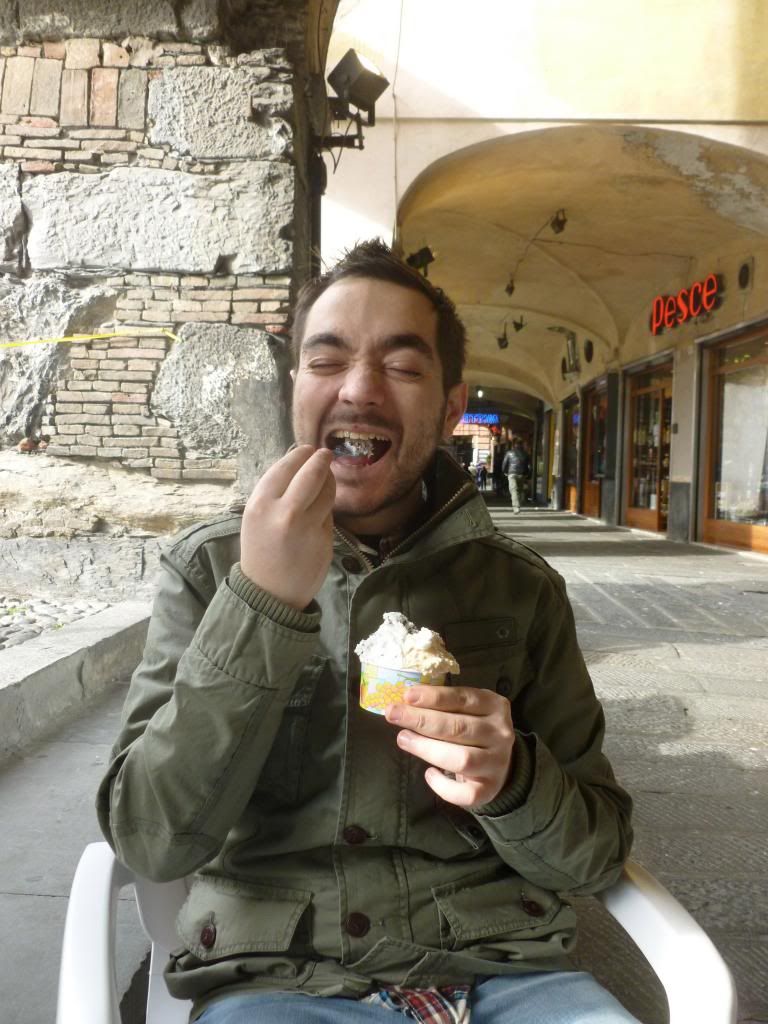
I have nothing profound to say about Gelato because its reputation precedes itself.  It's tasty. It's multi-flavoured. It's so quintessentially Italian.  And any time of day, any weather, people--young, old, fat, skinny, are eating it.  Gelaterias are everywhere and the flavours are endless.

Paul and I made gelato a daily habit. On a 12-day holiday, there were only two days when our paths didn't cross the sugary frozen delight.  Paul had his favourites--Nocciola (hazelnut) and I had mine--Coconut.  Though we did make attempts to range around the flavours, this was mostly in vain.

Nocciola on the seaside 

Mint and cookies and cream on the seaside 


Bacio (chocolate and hazelnut) in the City 
Stracciatella (chocolate chip) in the country 

We did attempt to take more photos of the ice cream but, you know, melting happened.  

30 April 2013

Cinque Terre

Disclaimer: I'm not sure how this happened but I've got two posts on our day trip to Cinque Terre. But I wrote them so I'm keeping both. 

Disclaimer Done: Let's go way back in time (i'm writing this in November 2018) to a place in Italy I'm sure you'll have heard about. I say this because nine out of ten tourists we ran into spoke with an American brogue. I blame this on Rick Steves, on cruise ships, on Cinque Terre's own stunning beauty that makes it so damn picturesque.

But it's also a victim to its own success. The town is literary crumbling under the weight of tourists' feet. Rockslides and landslides are common and CNN has listed it as one of the places NOT to visit in 2018.

As the cinque in the title would suggest, the region is made up of five separate villages: Monterosso a Mare, Vernazza, Corniglia, Manarola and Riomaggiore. A train runs up and down the region and connects all five villages. For the more adventurous, you can walk from one to the other.

We were on a bit of a reunion tour with the retired couples we'd taken the wine tour with on the previous day and so we took the train, stopping in each village for an hour or so. Most of my photos have disappeared; here's what's left.

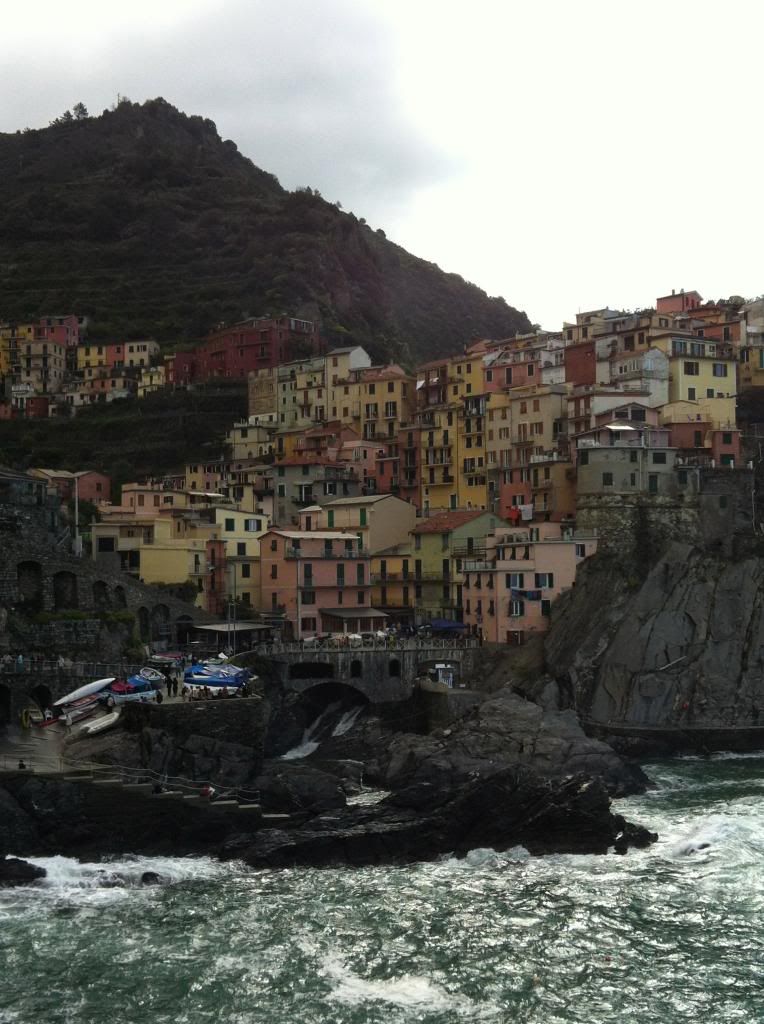
Manarola is the town with perhaps the most iconic view. The town's residents depend on tourism to stay afloat but some terrible flooding inundated the village in previous years and brought it to a standstill.
Fegina Beach in Monterosso, the longest stretch of beach in this little haven.
When my pictures one day return, I shall update this further. But for the time being, considering it's taken me this long to post, I'm going to settle for happiness in there being anything at all to document our time in Cinque Terre.

Cinque Terre National Park

Cinque Terre has long been on my beautiful places I need to go list.  Unfortunately, I missed the memo that it was on everyone else's list too.  But before we knew this information, Paul and I paid a hefty touring fee to make our way to the 5 villages built into cliffs with our geriatric wine tasting tour group from the previous day.  We convened at the mini-bus near Lucca train station bright and early in order to journey towards the sea.

Cinque Terre National Park is a series of five villages built into the jagged cliffs of the Ligurian Coast with a series of winding paths and trails connecting each of the villages.  Ambitious travelers make the journey between each village on foot; everyone else gets on the train-cum-monorail that makes four or five stops per village each hour.

Part of the reason for Cinque Terre's popularity is because of its stunning beauty and status as a UNESCO World Heritage site; but then Rick Steves wrote a travel guide detailing the ins and outs of the region and every mainstream traveller with Italy on the brain made it a focal point.  Then the guide was translated into every european language and the hordes kept on coming.  We were confronted by groups of French, Italian, German and Scandinavian pensioners at every point.  Hordes of rude travelers who looked like your granny but acted nothing like the prototypical cookie baking, hug giving lovelies that told you stories about growing up during harder times.  These grannies pushed, shoved, cut in front of you in the gelato queue.  They used their canes and zimmer frames to chop you down as you tried to get a place on the train or walk up a path.

Not impressed.

Fortunately, the few Americans we ran into on the trip (plus the ones in our tour group) were quiet, friendly and avoided all this pushing.  As I glared at Yvette, the bozo-red-haired French tour guide who shoved me aside to get my seat, I felt pride for my nation.

Despite all the insanity, the stunning scenery failed to disappoint. We only journeyed to three of the five villages--Manarola, Vernazza and Riomaggiore.  The full effects of the flooding of 2011 could still be seen in many places but the communities seemed to come together and help each other rebuild.
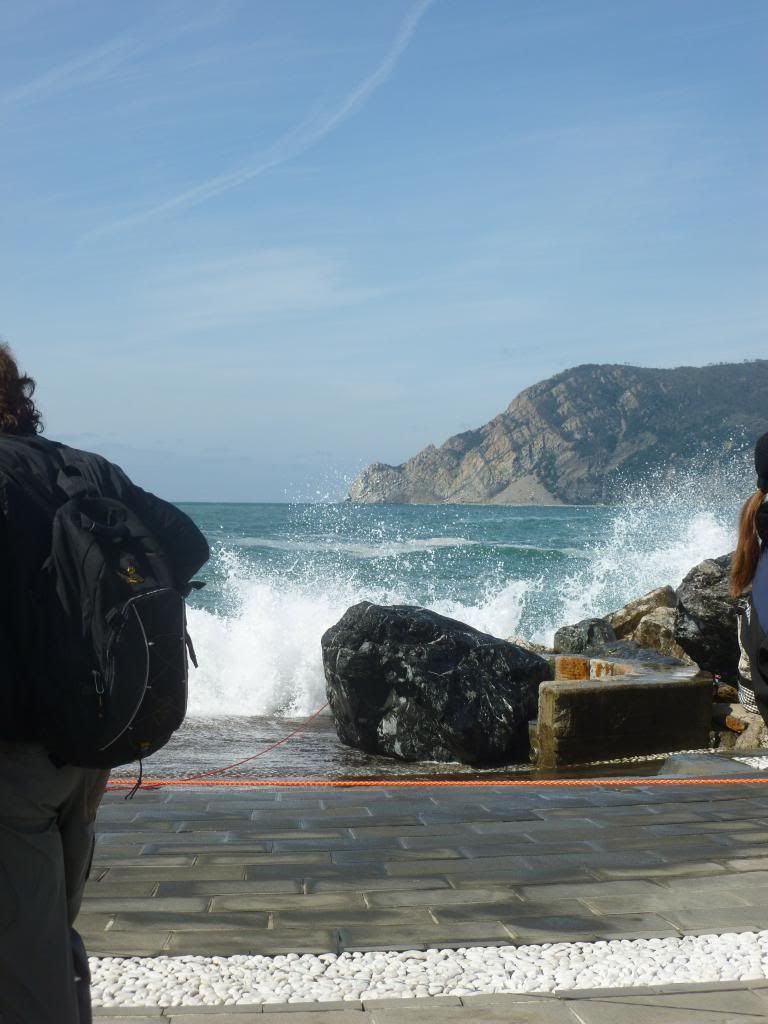
The Village of Monterosso.  If you look super closely on the rocks, you'll notice an intrepid (read: stupid) Asian man.  He decided to go scrambling up the rocks during high tide and a wave crept up (read: roared up as they had been doing consistently for the past hour) and whooshed him away.  He disappeared into the mist, hit the rocks and climbed back up clutching his digital camera and other technological paraphernalia.  Darwin Awards were made for this man.  
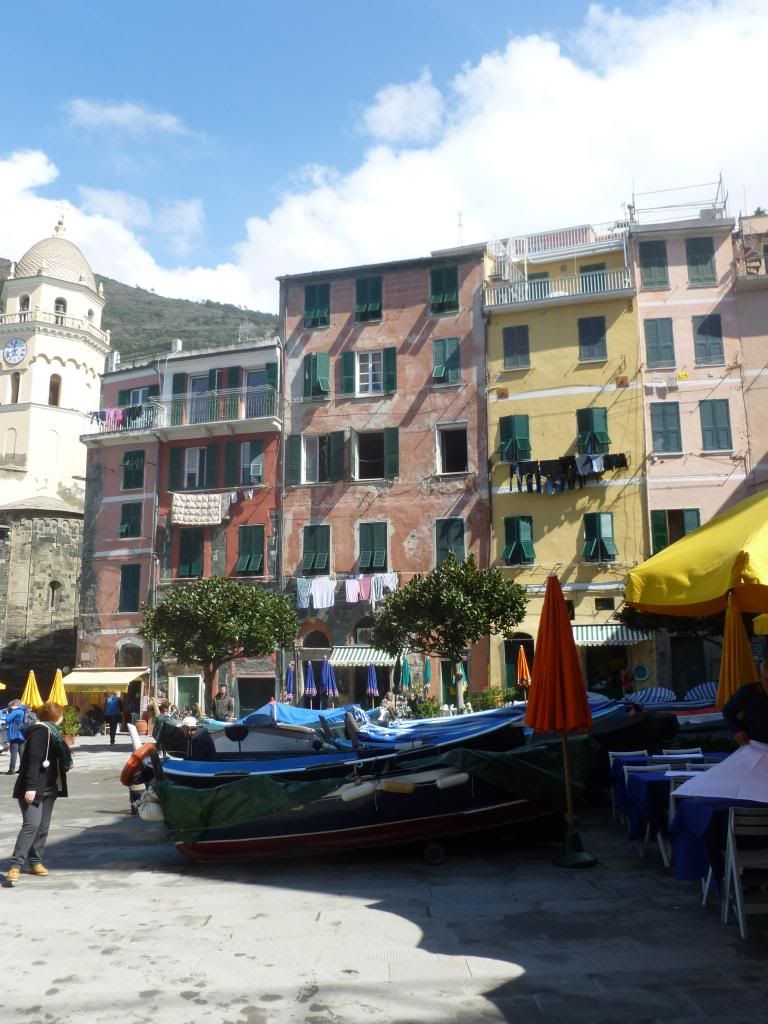
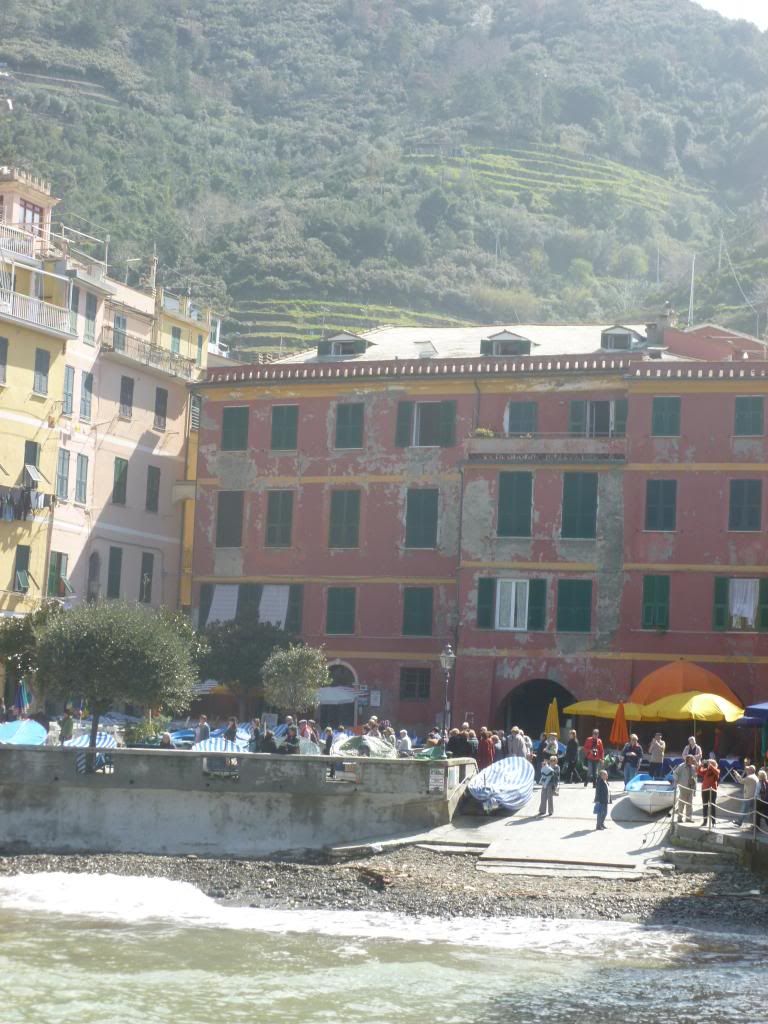
Next stop, the village of Vernazza.
With a small, sandy beach and cute cafes, this was my favourite of the three.


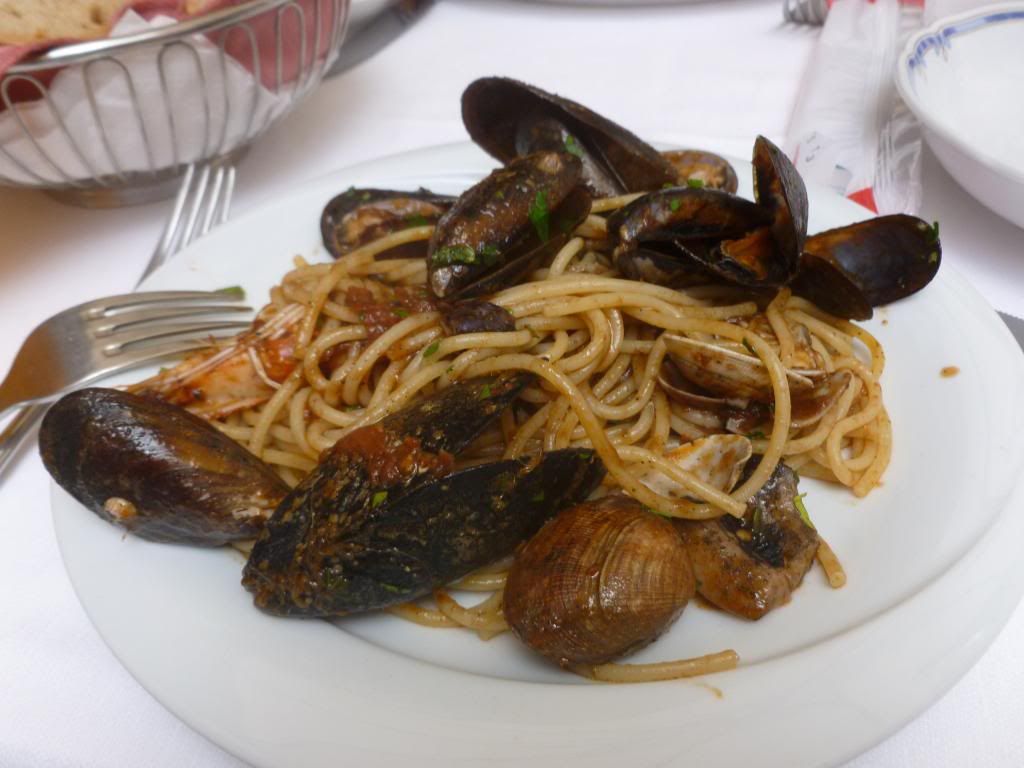
Last stop, the village of Riomaggiore. It's the biggest village by quite a bit and we ended up in a shop doing some more olive oil, wine and truffle oil tasting. Paul tasted the local gnocchi and I had a beautiful, beautiful bowl of seafood pasta.  Because of the size of the village, it was easier to forget that a million and one grannies wanted to elbow us out of their existence.  The sun even made a more than temporary peek from behind the breezy clouds. 


Fed, watered and gelatoed, we ventured back to our little tour group for the world's best car nap avoiding most of the rest of the day's annoyances.  And really, I'm glad we went because Cinque Terre is hard to explain until you're there.  But we went in April. It makes me wonder what July would be like.  And if I were offering any advice about the whole experience, i'd venture to say you should spend a night in one of the villages--away from all the day tourists, it might be a completely different experience.  And I can imagine a village full of cliffs and stars might be a lot more like the Italy Rick Steves wrote about.  

Because he definitely didn't mention any cane-wielding grannies.