8 August 2013

Greenland Hotel, Agona Swedru


Today Ghana called a national holiday because the new moon was sighted and Muslims across the world celebrated the end of Ramadan. Ghana has a growing minority of people practising the Islamic faith so they give everyone a day off to celebrate with their families and enjoy one another. For us, this meant no school. And as exciting as those words usually are, I was a bit disappointed because we're only here for two weeks. 

But after a week of 6am wake ups, a lie in was a welcome relief. As I yawned and stretched at nine, I was greeted with sunshine, something we haven't seen a ton of these last two weeks. I'm not complaining; the weather's been warm and humid but in a Michigan cloudy, hazy day kind of way. Direct sunlight therefore meant we could laze away at the hotel pool, one filled with a variety of flora, fauna and insects, but a pool nonetheless.
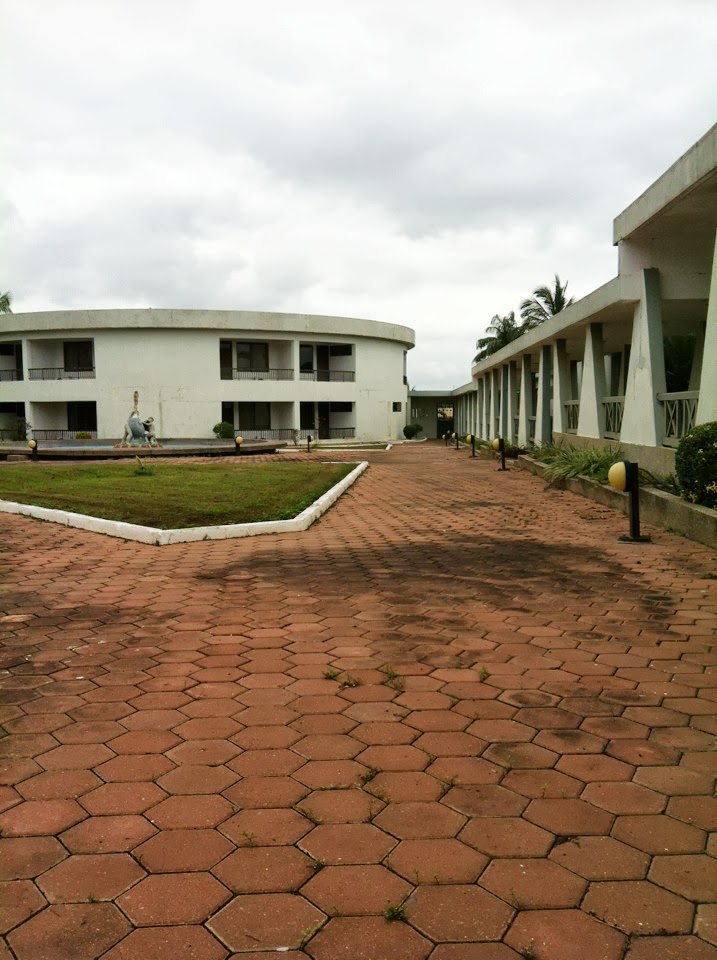
This may be the highlight of our accommodation, The Greenland Hotel.  I'd like to believe the hotel had its heyday in the 1960s.  With its tennis court, pool, geometric shaped everything and casually molding fountain, it reminded me of Kellerman's Resort in Dirty Dancing.  Pictures of successful events gone past and awards long won lined the walls.  There's even a discotheque downstairs.  But like Kellerman's owner Max says at the end of the film, 'teenagers want trips to Europe..12 countries in 9 days...not this anymore', the relics of the past palpably haunted the spacious venues.

In the rooms, the ghosts feel even more present.  Once 'modern flourishes' have become dated--wooden paneled ceilings, yellow bathroom fittings, floral curtains.  Oppressive mahogany furniture steals any light away from wide windows and the fluorescent light bulb dotting the ceiling chooses the days it wants to work.  On day three the limited cold water I had started leaking into the bathtub and ceased working.  I'm opting for bucket baths in Wendy's room instead.  There is something deliciously refreshing about this.  My air conditioner also sounds like it's about to take off, and my daily routine has become checking under the bed, in the bathtub and in the broken wardrobe before I go to sleep.  This has been a challenge--I don't sleep well in new places at the best of times.


Essentially, my room could be the scene of a bad porn.  Ironically, when doing some online searching, another member of the group found that this was indeed the case.  Which made sense why my welcome gift from the hotel was a box of 150 condoms, a pamphlet about how 'Safe Sex is Fun and Easy' and a bible translated into three languages.

Despite all of this though, the staff has been lovely and accommodating.  We appear to be their only major custom.  We've drank their bar dry--not a difficult task with 20 of us.  But the wait staff have gone on to deliver little surprises, strawberry ice cream, chicken sandwiches, chips.  So despite the fact that i'm convinced someone is going to break into my room and murder me in my sleep, i'm culinarily well considered.


Alas, with our last day to be tourists in Agona, we've had a morning poolside playing chicken against the African sun.  The darker/smarter of us who applied sunscreen fared better than others; being this close to the equator does things to the strength of the sun.  The braver of us ventured into town one final time to pick up various bits of tailored clothing and have one final properly African meal.


This is how I discovered fish in palava sauce with yam, fufu in goat soup and red red with plantain.  Minus the goat, which I didn't try, it was all nice in that way you'd try it once.  To be fair, actually, fufu is probably the only thing I wouldn't order again.  It's quite hard to explain--a lump of play dough type consistency that you pick apart with your hands and dip into soup.  It tastes like not much but is still strangely satisfying.


Food photos to come!

7 August 2013

Talk of the Town

The local community seem to have cottoned on that we're in town. Today, we had a series of shouts greeting us with 'obruni!', to which the twi translation is 'Hey You! White person!'' considering the potentially offensive nature of this comment, it is probably important to note that this happens to be our main distinguishing feature. I have never stood out more.

The greeting is usually followed with an 'etisenne?'. If we respond with 'mehuye', fine thanks, people cheer and poke the person next to them. Others, usually braver, more fearless children come up to us staring and ask 'how are you.' in English. When we respond they either stare back in wonder or run away smiling. Walking through the market, the lady selling gigantic (seriously, seriously gigantic) snails had a similar reaction to us than we had to the snails. Then she tried to sell us some.

I think today's highlight though comes courtesy of a step located on a dusty side street off the market. Janet, Wendy and I sat chewing through the Ghanaian equivalent of a chocolate ice lolly. As we watched the world watching us, we were greeted, waved at, stared at, welcomed and smiled at. Traffic briefly stopped. A street vendor took a seat across from us and eyed us warily, waiting for us to do something crazy. I think we disappointed her when all we did was eat.
Later, when I briefly lost my friends, a group of women all pointed down the street and into a shop: 'your friends are that way.' Very helpful.

The local dressmaker also knew who we were. A group of more experienced seamstresses manned sewing machines in the balcony. I asked one lady if this was the place another friend had been in. She replied with a: 'yes. Your friend, she's tall and a little bit wide. Yes she's been here.' Pull no punches ladies.


I was then introduced to Madam, a short, fierce looking woman wearing a beautiful, clingy handmade dress and yelling into her mobile phone. She continued to yell as I proceeded to be sat down in front of an array of dress catalogues, prompted to skip patterns that wouldn't suit my body shape, age and style before being measured: chest, hips, bum and even the distance between my nipples. I was asked if I planned on hoiking my boobs up any more than where they were already; I gave an answer and was given an approving nod before being re measured.


Madam operated a swift, efficient business noting down all numbers in a carbon copy log sheet. Her seamstress apprentice minions fluttered around me, some at beautiful, hand wound singer sewing machines, others watching me make my decisions. Everyone was on their toes--I get the impression Madam doesn't put up with any crap.


And when all the particulars were done, I gave her my fabric (bought at a stall in the market--3 yards for 20 cedi/£6.50), agreed a price (25 cedi/£8) and a pickup date in two days' time. I hope the dress turns out half as beautiful as the dresses so many of the women wear here--I don't have the bum to pull off half the fashion nor do I have the skin tone, but if I can pull off a funky pattern back in the UK, I'll call it a success.


It was more of the same on the walk back to the hotel. People made busy getting on with their lives whilst we temporarily caused the day's gossip for some of them.

I can't help but fall in love with this country.

4 August 2013

Pioneering in Agona Swedru


After a week in Accra the group forged into new territories and made its way to the central part of the country and into Agona Swedru. This is a new venture for Warwick in Africa and thus for the teachers in the local area.
For context, the closest cashpoint that accepts foreign cards is two hours away. People take out their phones to snap away pics of the 'white people on a bus!' Openly, we get stares and smiles. Our school is a forty minute drive down dirt roads; this is the 'close' school. And on our way home from the close school, Ellis, our driver, hit a baby goat napping in the middle of the road. 

And still. 

Swedru is charming. Hardly a tourist destination and absolutely off the beaten path. But it's real in a way that a big city can never be.  Let me explain--London is a shoddy representation of how England lives. It's full if immigrants (of which I am one), it carries a bulk of the country's wealth, universities, jobs and infrastructure. It's easy to see extreme wealth standing proudly next to extreme poverty. And in many ways, Accra is the same. 

In Swedru, what you see is what you get. The community is relatively rural--corn fields and palm trees stand side-by-side. But the houses we've seen are a lot more solid--less shack like structures and more concrete buildings. There's a greater Muslim influence here too--Islamic schools and mosques dot the area. Nobody bats an eyelid. Life revolves around the local church or mosque and people seem to care about each other. It makes me wonder when western society became so insular, so selfish and so blatantly consumerist. 

As for the schools, the ones we've seen and been in are more cared for. They seem more modern than their Accran cousins, and the campus of the senior high school we're teaching at is similar in size to Hornsey. 

In town, a huge market splits the area in two. It's a true market--with foods and smells and goods for sale. Like any true market, it assaults the senses; smoked fish seem to be the thing for sale here, vendors beckon you to buy their fish, their spices, their truly gigantic snails. No one hassles or heckles you though--you are free to browse as you please. Another welcome change from Accra.  And if you venture back, you'll find stalls and stalls of fabric, tailors and seamstresses. Fabric is inexpensive and getting something made is even cheaper. I've paid 15 cedi, the equivalent of £5 ($7)  to have a shirt made for Paul. 


The rest of the town's streets are dotted with shops, a small grocery store selling British biscuits imported from China with mandarin script on the side, various tailors, coffin sellers and ridiculously named store fronts. There is also one restaurant: Sizzlers, that sells an array of Ghanaian food alongside burgers, chips and pizza.


It's quieter than Accra but is still by no means quiet. You can find everything in one area that spans the distance of roughly a mile.  The open sewers still smell and traffic still abounds, particularly on market day.  But somehow this place feels a bit more real.  It's not everyone's cup of tea.  
Fortunately for me, I don't drink my tea like everyone else.

3 August 2013

Drama, Ghanaian Style


I am aware that very little of what I've written this far eludes to why we're actually here. In this way, as you will find out, my title gives nod to subterfuge and entendre. But Before I get carried away listing words I learned in preparation for the GRE, I should note that I am in Ghana because I am, in fact, teaching master classes to the teachers out here.

This makes me sound like some kind of  megalomaniac, I am aware. But teaching master classes is a lot like sharing best practice to a room of people who won't boo you off stage or talk about you when you leave--like your fellow teaching colleagues do at home. 

Our Ghanaian colleagues have been warmly welcoming and very receptive to the myriad tasks at hand. They whoosh and soundscape with aplomb. Their challenges are different--extremely limited resources, gigantic class sizes, a government that doesn't quite deliver (okay, that one's the same) but their true professionalism is refreshing.  These teachers care about their kids and their continued professional development, in Accra at least, has been top notch. 


In a week filled with drama, they have been the true saving grace.

As I spout irrational chatter about my teaching background and then sessions on drama games in the English classroom, interactive learning, inclusion and differentiation, I'm also very aware of how far I've come in my teaching career. And how much I do have to offer the educational scene. It's a rare confidence boost in an educational landscape that always focuses on better, more, quicker.  

There are issues at hand, still.  The WASSCE, the West African Senior School Certificate Exam, mandates a very different style exam to the UK's GCSEs.  Until this year, we've been unable to get our hands on an exam paper or test booklets.  And now that we have it, it seems that our sessions have been delivered at cross purposes.  Teaching PEE and interactive methods is all good until you note that the exam is multiple choice, focuses on idiomatic phrases, grammar and basic comprehension.  This isn't Ghana's choice; they're at the mercy of the West African board.  So if positive change is going to happen, it's got to happen on a much larger scale than we once imagined.  This is a daunting task.  

If infrastructural progress on the ground is anything to go by though, it's a challenge the Ghanaian people are up for.  

1 August 2013

Dont Drink the Water; Don't Eat the Rice


Every human being fancies him/herself a bit invincible at one point or another. It is the inability to face reality that ensures the human race progresses. But eventually we are all forced to confront our bodily limitations in various shades of humiliation. 

Rash overgeneralisations aside, this week's brought-to-you-by-Ghana-push-to-the-limit-moments have involved migraines, diarrhoea, explosive diarrhoea and an overnight trip to the local hospital. 

Fortunately, only one of the above situations involves me, and seeing as you're reading this you probably know that if I went to hospital the whole world would've known about it last week. So I'll leave my fragile condition to your imagination. 

I will say this. If you thought being sick at home was fun, you should try it whilst flirting with the idea that: 1. The school's toilet only flushes on a good day (and its  last good day appears to have been last July when you were here); 2. malaria tablets only work if you can keep them in.

Having learned a valuable life lesson when I accidentally food poisoned myself last May and still went to work, this time I green facedly bowed out of teaching for the day. Instead, I spent a morning rotating between my bed, the toilet and a bevy of bad films on Ghanaian television. Though I felt remarkably sorry for myself and annoyed that rice is one of the foods with the highest propensity to grow angry-faced bacteria and the only real 'vegetarian' option in a country of rice and meat eaters, it could've been worse.

And for Stacy, one of the student teachers, it was. Stomach bugs are relatively common to western stomachs in Africa with the change of scenery, change of climate, daily dose of anti-malarials, difference in hygiene standards. With me, it was a nuisance. For the student teachers who were sharing rooms, and therefore germs, it became a mini-epidemic. At one point last week, 5 of the 10 student teachers were so unwell they couldn't go to school. 

Unfortunately, Stacy had  pre-existing medical conditions of the autoimmune variety. She became dehydrated after not eating or drinking for nearly three days and thus the decision was made to take her to hospital. Initial reports of conditions there were grim: digging for veins with a needle for ten minutes, filthy ward conditions, the dying lying inches from the immunocompromised. Walking blood and stool samples on your own to be tested and picked up, referring to the price list and  paying before treatment.  Fortunately, the doctors were ace.

Too many things hit home for me though. We never had any serious brushes with sickness last summer and dealing with hospitals never occurred to me. I never considered the medical compromises a Ghanaian makes, not a choice but a reality. And because I love someone immunally challenged, it made me so eternally grateful of a National Health Service that's stretched to the limits but is head and shoulders cleaner, safer and more efficient than here. No judgment. No disrespect. This comes from a place of genuine fear. 

So there Ghana goes teaching me something else. 

As for Stacy, she's doing fine after her brush with bacterial gastroenteritis. She  won't be eating the rice any time soon. Me, I'm tucked up in bed with my new best friend, the anti-bacterial hand gel. We've become close these last few days; I reckon it's a relationship built to last.