2 October 2015

Seoul's Neighbourhoods

I am restraining myself from punning, of baring my heart and Seoul, of Seoul searching. Yikes, too late. This city has an energy that's hard to put into words. What's possibly the best thing about it is something I experienced in going to New York City for the first time. It's that popping up into a new part of town and experiencing a completely different neighbourhood. Every district has a distinct tone. On our five-day stay we didn't make it to every part of the city; but what we did see felt like a unique piece of a gigantic puzzle waiting to be solved. 

In Gangnam, we witnessed more plastic surgeons per-capita than people. Girls with bandaged noses dotted cafe tables, trendy shops abounded and you could practically feel the dance craze down the streets: 
 
Bukchon hilltop village was perhaps my favourite. Antique shops, trendy stationery shops and tiny clothes shops dotted the ancient lanes. The streets wound up and up offered good views of the city below: 
 
 
 Traditional houses and rooftops dotted the landscape and even the odd artist took inspiration. It's very probable that one neighbourhood blended into another here but I think that was part of the fun.
 
Nearing Gyeonbokgung Palace, we were greeted with some odd art, statues linked to the signs of the zodiac:
This, according to our local experts, is a nod to some childhood game. We were relieved...
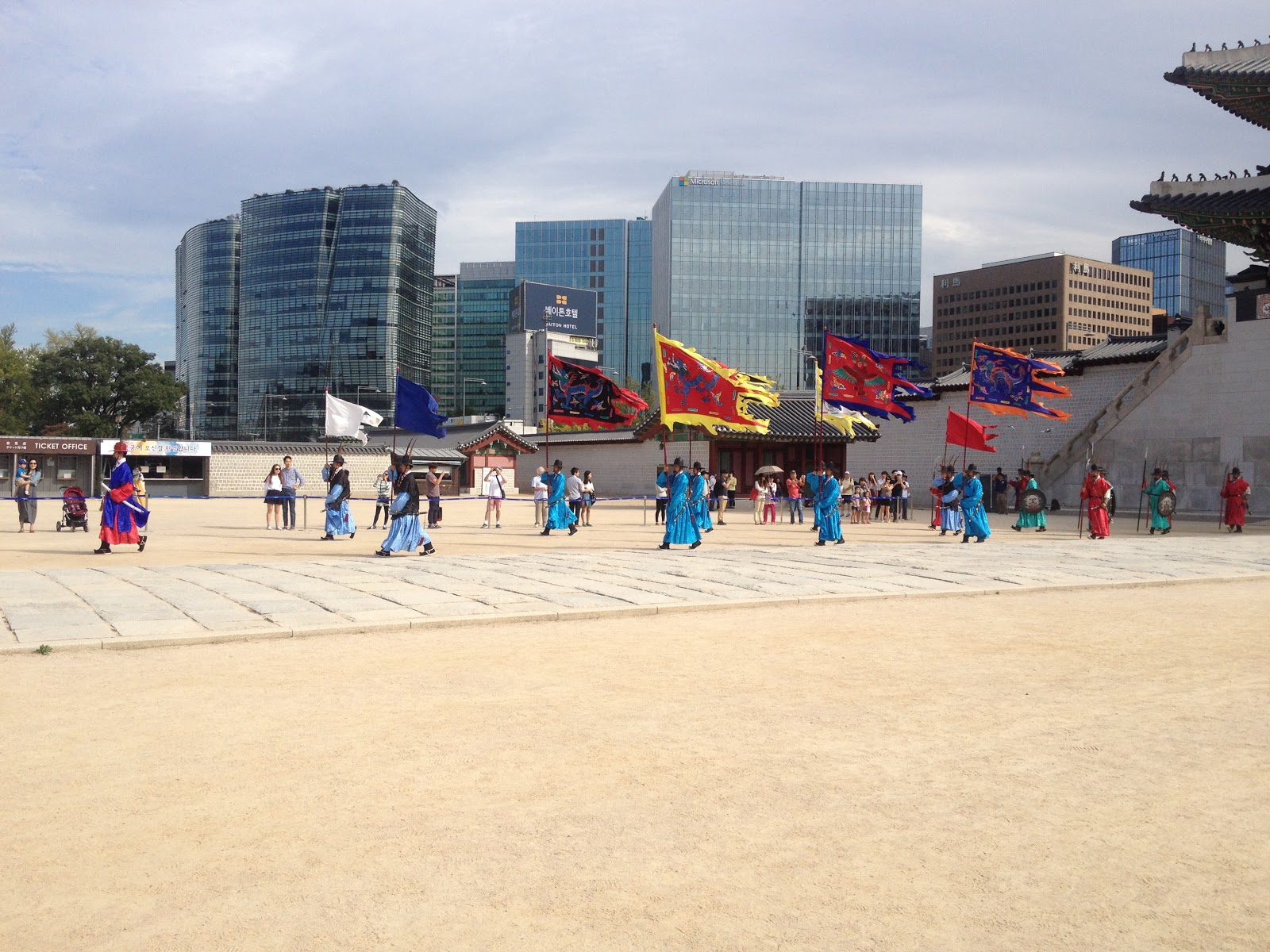
 Gyeonbokgung Palace itself was also quite impressive. Its location in the middle of the city made it easy to dip in, enjoy the fresh air, and pop out the other side.
 
 
 The changing of the guard:
 
 
Hongdae, the district we're staying in, is considered the hip and trendy part of town. Its location near the university district helps this quite a bit. Street markets, at night and day, restaurants, both cheap and more expensive, and a series of shoe shops, clothes shops, dessert shops make it the place to be.
 
At Insadong, a wide pedestrianised market cuts off into little side streets. We didn't have enough time to explore this area but it's definitely worth a look for all those bowties, art supplies and hipster gear you might want:
 
 
For a taste of the outdoors, head to Myeongong, pass the hordes of shops, hang a right and take a leisurely hike. You can take the lift or walk up to the heights of Seoul Tower, where glorious views of the city await: 
 
 
At the top of the tower, you can post a letter from the highest point in the city. And let's be honest, who wouldn't want to do that? 
 
 
A brief wander through Itaewon takes you to the War Memorial of Korea and the vast complex built in commemoration of the lives, many American, lost in the conflict. I've never seen so many American servicemen anywhere outside of the US.
These pictures don't even do half the city half the justice. Given more time, or perhaps another trip, there's a million more neighbourhoods to shop, things to eat and definitely streets to pause and people watch. What a place.

1 October 2015

Coffee and Eats, Korean Style

Seoul is the home to a million cafes and coffee shops. Some ones you know, like Starbucks, even if you do have to do a double take to check out the sign:
But mostly, they're ones you don't know. They're trendy or crazy after often themed. Case in point: 
Down the street from: 
And these shops have funny names with sometimes profound messages: 

To add to the levels of quirk, Seoul takes theming to a new level. Cats, dogs, puzzles, you think it and it exists: 
Korea also introduces people to the concept of 'Dessert Cafes', coffee-shop like wonders where dessert reigns supreme and brownie milkshake concoctions raise the chance of diabetic coma dramatically: 
And that's only the beginning of the true food feast. Having limited knowledge of Korean food, I assumed this cuisine boiled down to meat and rice. In a way, it kind of does. But with the addition of kimchi, pickled cabbage, spicy sauces and sizzling vegetables, Asia has another powerhouse of food. 

Fried fish, tempura style, with bowls of steaming Korean rice: 

In Namdaemun market, we ducked into a traditional Korean restaurant for bowls of bibimbap,  rice mixed with fried vegetables, seaweed, chilli pepper paste, soybean paste and different types of kimchi. If you eat meat, there might be some of that too: 
 
When mixed all together, it becomes a delightful mish-mash of flavours and textures:
 
Later in the week, we made our way out for Korean BBQ at one of the city's ubiquitous restaurants. From the windows, all you might see are low tables with spaceship-type attachments that turn out to be vents for the grills below. At smaller tables, a waiter brings out big nearly-table-sized grills and smoking hot charcoal to heat the food beneath.
As a table, you watch, flip and eat the food as it becomes ready. Proper vegetarians like my friend, Mel, are fed bowls of seaweed and rice that are hand stirred and formed. Courtesy of the plastic glove, you save yourself any mess. 
 The concept of eating while you drink is also a thing that Korea embraces wholeheartedly. Cynically, it ensures that restaurants make enough money by selling more than just cheap alcohol. We were introduced to this idea by a Korean friend of a friend who ordered us a steaming plate of deep fried vegetables to wash down the soju, a strong Korean spirit that varies between 20-5% alcohol by volume. It's rumoured to be 'tasteless' but that's kind of hard to believe when it hits your tastebuds, and your stomach.

Due to lax production laws, the spirit varies in strength, taste and colour. Sometimes it's poured into cocktails but we chose to mainline it and chase it down with our beer and very fried food. That may be how we ended up with this stuffed animal. I can't quite remember:
 
I'm fairly certain we stumbled on beyond this. To bars and market stalls in the trendy and bustling Hongdae district of the city. To be fair though, the food was good in every part of the city. Every meal offered a new and exciting taste and, happily, being vegetarian was not a problem.  Winning all around.

The DMZ

A fascinating part of the Korean psyche is the ongoing hope of reunification with the North. Across the city, reminders that unrest is part of the recent past remain. The Armistice Agreement was reached in July 1953 but this is only a tepid compromise. In the south the message seems to be--the war's not over until North and South are unified. It doesn't feel unsafe or sinister; there's an almost hopeful promise for the future. 

This manifests itself in various ways. Under the South Korean constitution, running of North Korea is technically still part of a united Korea. There are offices filled with civil services ready and waiting to run a united country. The BBC covered this in a fascinating article that can be read here. 
More immediately, on our tour of the Demilitarised Zone, a two km wide no-man's-land between North and South, a train station and tracks wait to connect the South to Pyongyang. Everything is modern albeit empty; it's like some eerie ghost town.
As part of our tour, we stopped several places in the DMZ including: a tour of one of the four tunnels built by the North Korean army to infiltrate the south;and the museum built to explore the history of the area. It's a bit unbelievable that the DMZ is a short 35-miles away from the busy Korean capital and it made our day's sights all the more concerning. 

We begun by donning hard hats and taking to the third tunnel, discovered in 1978. At just 52km from Seoul, it was considered the North's most viable threat to peace in the region. It is a true testament to human persistence--the depth and comprehensive length demonstrate North Korea's governmental attempt to destroy/infiltrate their neighbours.
From there, we walked around Imjingak Park with its panoramic views of  Freedom Bridge and the North. Miraculously, one good thing has come from this conflict. The DMZ has returned to a haven for natural habitat. Birds, water fowl, flora and fauna that haven't flourished in other parts of the country exist here. And so in a paradoxical way, the DMZ is actually kind of beautiful. 
Flags, barbed wire and strips of fabric in commemoration of lives lost, families separated, bring things back down to earth rather abruptly.
Dora Observatory, located close to the third tunnel, was our final stop. Here, from viewing binoculars that you plunk the 25 cent Korean equivalent into, North Korea lies in wait.
Little can be seen except for what the South has labelled 'Propaganda Village', a small town of low rise buildings, farmland, a statue of Kim Il-Seong and a flagpole.
The flagpole (not pictured), is a thing of legends. Apparently, the North and South are in competition for whose is bigger. Call it a flagpole pissing competition. The South had the taller one so, one night, under the cover of dark, the North extended their pole. And on and on.
Although we didn't make it as far, tours take people to Panmunjeom, also known as the Joint Security Area. Here, UN peacekeepers, South Korean and North Korean soldiers stand face-to-face, obviously wearing sunglasses at all times in order to avoid deadly eye contact. I mean this in no joking manner; soldiers avoid the confrontation of eye contact that could lead to a deadly flare up of feeling here at the border, rain or shine. 

Back in Seoul, military men in uniform, evacuation plan signs and fire extinguishers on the metro do more to remind everyone that the government is on guard.  This is all in conflict with the well-designed, polite, open-minded city that is the more immediate reality. The fear of destruction is real, the hope of reunification is there, but these ideas don't rule the day-to-day.