16 April 2023

Israel and Palestine--Welcome to the Madness

Depending on who you ask, Israel and Palestine conjure up images of: The Holy Land (my mom); getting blown up in a cafe minding your own business in Jerusalem (my dad); the best falafel spots in the world (my Israeli students). There's more flags per capita than you can shake a stick at--a sentiment I observed as a fallen-away American. And any way you shake it, everyone's got a thought on this small, complex, beautiful, troubled land a 5-hour stone's throw of a flight from the UK. 

So perhaps it would be tautological to saw we chose a tense time to visit Israel--10 days during Easter holidays 2023. In a country created off the back of World War and 'good old' British imperialism, tense is more than an adjective--it's a state of mind. 

Welcome to the Home of Religion 

We arrived in Tel Aviv, the liberal hub of the country, on Wednesday 5 April, three hours after sundown, notable for its religious significance in this context. It was the first day of Passover, a 7-day Jewish memorialisation (and appreciation) of being passed over by the various plagues of ancient times. 

As per Israeli law, public transport was shut for the first and last day of the holiday. All public transport. Even from the airport. And so greeted with a two-hour taxi queue, we paid double the going rate to get to our accommodation near Tel Aviv Old Port. 

Travel tip: should you wish to travel to Israel at any point, be mindful that transport also stops from sundown Friday night until sundown Saturday night for Shabbat. Depending on what city you're in, many/most shops and restaurants will also close. First trains on Saturday evening, run a couple of hours after sunset, buses a bit earlier. There are city-to-city transport options called sherouts, but they're likely out of the comfort zone of casual travellers. More on that to come. 

Interestingly, when I spoke to my Israeli colleagues, neither mentioned any of these quirks. Or how they might affect our travel plans. 

Adding to this Moment of Religious Significance, it's probably also important to note that 2023 is the first time in 33 years that Passover, Ramadan and Easter all coincide with one another. In the seat of the world's three major monotheistic religions, what could possible go wrong? 

Enter the Political Reality 

Meanwhile, political tensions were bubbling up and blistering once again. On the 27th of March, after weeks of mass protests that saw thousands take to the streets, Ben Gurion airport was forced to shut after unionised airport staff joined members of the public and army reservists who refused to be called up on the streets in protest of controversial changes to the judiciary the government was trying to force through. This is only a tiny part of the equation of an increasingly right wing government agenda that threatens peace in the entire region. 

Their 'demands' were met, if only briefly, and the government backed down. But the whole time we were in Tel Aviv, we were met with demonstrations, signs and peaceful protests. Israeli people have a lot to say about the future of their government. 

Sectarian Violence 

To add to the unrest, political and religious tensions coalesced the night before we arrived when Israeli police clashed with worshipers at the Al Asqa mosque in Jerusalem, a site claimed by both Jews and Muslims as sacred. After Ramadan prayers, a group of worshipers barricaded themselves in the mosque, in parts to exercise their desire to pray until dawn, a violation of a longstanding compromise that allows non-Muslim visitors entry to the site early in the morning. But also partially due to threats from ultranationalist Jewish extremists; as part of an ancient Passover tradition, they wanted to sacrifice a goat on the site. The ensuing skirmish between heavily armed Israeli police and those inside the mosque saw anywhere between 14-50 people injured, which fuelled further unrest. 

On Thursday, the day after we arrived, Lebanon retaliated by launching 34 rockets into Israeli-occupied territories, most of which were blocked by the Israeli Defence Forces. It was the biggest barrage in 17 years. Israel responded in turn, hitting several targets in Gaza and Lebanon. 

A day later on Friday, our second full day in Tel Aviv, on the road out of an illegally-occupied Israeli settlement in the West Bank, three British-Israeli Jewish women were pursued in their car, run off the road, shot at close range and killed. 

That evening, after a long day of wandering the city without data roaming, we returned to our hotel blissfully oblivious to a series of worried messages from friends in the US. In a rare burst of violence that made its way to the significantly more secular capital of Tel Aviv, a man drove his car into a group of people on the beachfront promenade (an area we'd walked through hours before), killing one Italian tourist and injuring six British ones before being shot and killed by an off-duty Israeli army officer. 

The Bottom Line

Life stumbled on--the beaches were busy, the cafes were full, people went on with their revels. Had I not looked at my messages, we'd have been none the wiser. 

On Saturday evening we checked out of our Tel Aviv accommodation to head to Jerusalem with a steely warning from our tone-deaf hotel receptionist: 'eek, Jerusalem, I never go there. It's dangerous.' The messages seemed to be hitting us from everywhere. And despite our city-dwelling Londoner cynicism, unrest became the spectre looming in the background. 

That's the peculiar notion about life in this divided, occupied land: you're safe, no one's going to steal your phone or mug you for your shekels (and goodness me, this country's expensive). But you might get hit by a rocket. More likely if you're Palestinian.

I have too many thoughts. 

25 March 2023

A Weekend in Madrid

One of the perks of international teaching is being sent away for training. Sure, it means setting a day's worth of cover, forfeiting a weekend and ascending the heights of peak extrovert in a group of other teachers. 

But it also means an all (mostly) expenses paid trip to a city that you don't live in. If you're unlucky, it could be somewhere like Bolton. Or Coventry. Fortunately, this time around I got shipped to Madrid, a city I spent a little bit of time in in the youth of my early 20s. 

I arrived late Thursday night in a fug of flight delays due to strikes over French airspace, winding my way through the eternity of Terminal 4 at Barajas airport only to be met with a 400-metre taxi queue that snaked and snaked and snaked its way down the outer edges of the terminal. A 12:30am hotel arrival made the next morning's start a bit rough but I guess that's show business.
I'm one of 14 teachers in my conference group and one of the more experienced IB teachers here. This makes a crucial difference to my other two conferences--an MYP one in 2017 in Vienna and a DP one in 2014 in Beijing--where I was entirely new to both programmes. Then, I desperately took notes to decipher the jargon that the IB uses to disguise what is actually a well-considered framework of conceptual practices. This weekend, I seem to mostly actually know what I'm doing. 

The weekend has, thus far, been a proliferation of: sharing best practice; meeting teachers new to the programme whose fear-fuelled gaps of knowledge of the DP I can appreciate; and finishing days at 5pm to slowly meander towards the city centre. 

The sun is shining, it's 20 degrees outside. And Golden Hour in Madrid is one for the books. 
Yesterday, I wandered with two women from the conference. Today, I needed a bit of down time for earbud wandering anonymity. Both have their perks. 
This evening, armed with city knowledge from one of my lovely work colleagues, I took to the city's streets chock full socialising friends lounging in the dwindling sunshine. It's a social place, Spain. And so, alone, I didn't stop often but I loved wandering the food markets, checking out the street art and popping into little boutiques. 
I eventually talked myself into sating my hunger at a little bar in the Barrio de la Letras, one of Hemingway's favourite neighbourhoods. My imposter syndrome is real and when I eventually stopped at Casa Pueblo, an atmospheric bar and people watching spot, I apologised profusely, in Spanish, for my bad Spanish. 
That didn't stop me from loving the wine and olives and tortilla. Or from appreciating that, despite my apprehension of eating dinner alone in a foreign city, I did it anyway. It may sound small and silly and completely trivial but it felt like a victory. 
So the pictures may look like I had a lot of time to wander. Alas, I did not. But rumour has it, one of my good friends from Shanghai has just got a job here. So I'll be back! 

15 January 2023

Resolution 2023

There's a saying that goes: the days are long, the years are short. And I find myself nodding along to that trite phrase staring out the window to a grey London sky on the dawn of this new year. The rainy grey dark makes it hard not to flashback to lockdown 3.0-- from January to March 2021--three months that pushed the UK public to the limits of their mental health. 

We're not there anymore. The world has opened up again. But we're now living the consequences of lockdown-cum-Brexit madness, not that anyone in the government is using the B word. The UK is in the midst of the worst recession since the 1980s. A solid core of people are choosing between turning on their heating and eating. Train drives have gone on strike at least six times in the last eight months, ambulance driver have taken their second round of strikes, nurses have opted to walk out for the first time in British history. 

We're the lucky ones in so many ways. We have decent jobs, we can afford insane inflationary prices, travel is not off the cards for us. But the current state of affairs still feels pretty grey.

Perhaps because of this, I've abandoned any attempt to make a new year's resolution in 2023. It's been a dwindling practice for a while now but this small act seems like the only two fingers I can lend towards capitalist systems that demand more, more, more all the time. I'm sick of the chaotic pace of work, of climbing a slippery pole and expecting to do this with a smile when more gets piled on the plate but it's a recession so just muck in. I'd like to abscond to kidney island, Paul and my fantasy tropical island where health problems don't exist and money is not needed. 

In the absence of this imaginary utopia, I'm doing what I can to reclaim the little in my sphere of influence. I'm taking advantage of cheap weekend flights to visit friends who live in sunnier European cities. (Hello, Lisbon! Hello, Berlin!) I'm taking Frank for walks between rainstorms. I'm attempting to find the beauty of weekend afternoons in London pubs, particularly ones with big fireplaces. 

In short, I'm still here. And if you live in London and have a pub recommendation, I'm all ears. 

2 November 2022

A Weekend in Jersey

 As a 40th birthday gift, my long-time friend, Dawn bought me a plane ticket to a secret location. She agonised as her prerequisites were: somewhere new; somewhere close-ish; somewhere with a reasonably priced flight. And so I rocked up at the airport with my passport and weekend bag none the wiser.

It transpires that to travel to Jersey from the UK, you don't need a passport but that would have given the surprise away and so we boarded our 45-minute hop to one of Britain's three crown dependencies just off the coast of Brittany, France. Dawn and I spent a lot of time trying to ascertain the status of Jersey. Is it a country in its own right? What does the passport look like? Where do taxes go? 

Our deep dives only offered us more questions but, officially: 'Jersey is a self-governing parliamentary democracy under a constitutional monarchy, with its own financial, legal and judicial systems, and the power of self-determination.' Thanks, Wikipedia! The island's relationship to the British crown is constitutional only; officially it is NOT part of the United Kingdom. 

But that's interesting for lots of reasons: the British pound is the official currency; the national language is English; cars drive on the left. And given we were there during the official mourning period for Queen Elizabeth, the pomp and circumstance for her was everywhere. 

Fortuitously, this also meant that lots of heritage properties were free to the public the weekend we were there. This is how we ended up on a charming tour of Mount Orgueil Castle, on Jersey's east coast. 

From the town of Gorey, every vantage point offers a view of the sea. Our wanders took us past beaches, groups of cyclists, wild swimmers and myriad families with dogs taking their time. The pace was unrushed and a wonderfully stark contrast to the busy of London. 

The restaurant scene on this part of the island is also pretty comprehensive. We accidentally discovered the The Crab Shack (listed in both Gorey and St Martin), an homage to all things crab and seafood. Between loaded crab fries and crab tacos, we were in heaven. Due to its proximity to France, champagne was also reasonably priced and so Dawn was able to help me check off on of the 40 things on my 40 for 40 list: drink champagne somewhere beautiful. Winning. 

On Sunday, using very good local public transport, we made our ways with bags to the (slightly) more bustling capital in St Helier and hopped on a local bus tour. We were pleasantly surprised. The open-top bus gave us the west coat highlights of this 45-square mile haven, taking us past St Aubin, the German Memorial, St Brelade's Bay and finally to La Corbiere lighthouse. 
We learned about Jersey's Nazi-occupied status during WWII and, given more time, would have opted to go to the Channel Island Military Museum. There's a lot of money on Jersey and we also got a glimpse of the fancier houses tucked away on this half of the island. 

Our weekend kind of ended there, with only a small glimpse of this tiny not quite a country but not not a country isle. I'd love to go back, take the ferry to Guernsey and back and soak up the sun, beautiful beaches and charm of this place. Definitely worth a visit. 

24 October 2022

San Jose

As a country, Costa Rica gets so much right. With its focus on sustainability and conservation, it set itself to be the 'most sustainable country in Central America' in the 1980s. In shooting for the moon, it landed far further and is considered a bastion of sustainable practices worldwide. By 2050, the country is aiming for complete decarbonisation, something it will likely reach. Pride for this, for the environment, for the myriad national parks and open spaces was evident throughout the country. 

Costa Rica's capital, San Jose, is not the likely representation of any of these policies. As the jumping point for most tours, tourists tend not to spend too much time here. Traffic is prolific, pavements and foot traffic are few and far between and, anecdotally, there seems to be a disproportionate number of pet cremation services in the capital. 

Despite this, I set off with Mini, Tony and Herbie in a little journey to the city centre. The grid pattern of streets wasn't exactly inspiring but some cool sculptures did adorn the pedestrian avenue. Al Viento, near the intersection of Calle 14 and Central Avenue, is an homage to the spirit of Costa Rican women. At nearly three metres tall, she rules the pavement. 
In front of the Banco Central, the Monument to Costa Rican workers stands tall. The bronze statues look both steadfast and imposing, representing the spirit of the people. 
The National Museum of Costa Rica 
Past all the statues, we made our way to the National Museum of Costa Rica, which is a rather impressive facility. At $11 for non-nationals, it's worth the price and gives you access to the museum and gorgeous butterfly garden. 
We started in the latter and though I took many pictures, this lobster claw heliconia happened to be my favourite. We'd see many, many more of these over the course of the two-week trip and they never ceased to impress. 
Inside the museum, pre-Columbian art dominates. Pre-Columbian as it pre-dating Christopher Columbus. A lot of it is indigenous, including this guy below, who holds his distended, worm-filled stomach. They can't all be winners. 
Outside the museum, we were greeted to a pedestrian-avenue of street art which felt pretty vibrant. With few other tourists around, we largely had the area to ourselves. We made it to our lunch stop just in front of the brief torrential thunder and lighting storm; we were the only people in the restaurant for some time. 
The Jade Museum 
As the rain continued, we donned our jackets and made our way to the Jade Museum, a multi-story collection, America's largest, that houses over 100 objects made entirely of jade. I enjoyed this exhibition more than I cared to admit and we took turns finding the freakiest, creepiest statues amongst the various rooms. The two below get my vote. 
Jet lag and museum closing hours ended our tour of San Jose there. I hadn't planned on spending much time in the city alone; given to my own devices I would have sat by the pool dodging the rain. And I wouldn't necessarily say anything on the day's itinerary was essential but I'm glad I got adopted by my new tour friends to see what I did. 

23 October 2022

From London to Costa Rica

January is always a long, dark month in London. And so I went to yoga in search of escape. As my yoga teacher, a smiling Mexican man resembling a teddy bear, led us into savasana, I stared up at the mix of sun and clouds through the skylight window. By the end of the 5-minutes, I convinced myself to book a summer solo trip I've been wanting to take for years. 

Group tours are not something I'd really considered in the past. But I got tired of waiting for friends to agree to travel with me and in the post-covid world, I wanted some peace of mind just in case I got sick on my own. Enter Intrepid Travel and their Classic Costa Rica tour. The 15-day trip started and ended in San Jose, the country's not-entirely-exciting capital. 

And so I paid my deposit and booked flights with Air Canada, taking me from London to Toronto to San Jose, landing 24-hours before the tour's orientation. I won't lie in saying that I was nervous: to travel with complete strangers; to share a room with a random; to traverse Central America, a sub-continent I had little exposure of. It transpires that it's the things you don't anticipate that are the real things to be nervous about. 

I'm a seasoned flyer but post-covid airports are a different satanic beast entirely. If I learned anything from the Bologna trip, it was to expect chaos. And so I packed a sandwich, snacks and 5 days' worth of clothing--shorts, a swimsuit, pants--into my carry on luggage. Boarding and takeoff were mundane enough and the first drinks/snacks service was in full flow when I noticed a bit of hubbub near the premium economy toilets, three rows diagonally from me. A flurry of flight attendants made their way to a woman who appeared to have fallen in the toilet with the door half open. Shortly therefore the 'is there a doctor on board?' announcement followed. 

And hence the new very specific medical emergency chaos began. The very inexperienced flight crew funnelled all resources to the woman, whom they eventually managed to lay down and cover in the bulkhead aisle space. Fortunately, medical personnel were on our flight and both a doctor and trauma nurse saw to the elderly patient who continued to pass out every time she sat up. She was not in a good way but did remain largely conscious whilst laying down. At 1.5 hours in, I assumed we'd either turn back or land in Iceland. But neither immediately happened and the flight tracker took us past Iceland, heading towards the coast of Nova Scotia, full steam ahead. At 4 hours in, no food or water passed out to anyone else, the announcement to turn back was finally made. 

This is how we ended up spending 2 hours on the runway at Keflavik. Paramedics boarded the flight and carried off the woman with her husband trailing behind her. Turning on my wifi, I had messages from Air Canada suggesting a delay but offering no tangible solutions. We continued to wait for food, water, announcements regarding connecting flights but none came. In fact, the flight staff got quite surly with anyone who asked even the most polite of questions. 

When we landed in Toronto six hours behind schedule, and two hours after my scheduled departure to San Jose, I was beside myself. But so was over half the flight, who were using Toronto as a base to fly all over North and Central America. And so I ran off the flight into the arms of a very kind gate attendant who escorted the whopping 23 of us flying to San Jose to our gate halfway across the airport. It transpires there's only one Air Canada flight per day flying to Costa Rica and 1/4 of us were missing from it. Flights for the next fortnight were already fully booked and so the airline had no option but to hold the flight. 

This is how I met one of the families on my Tour. Tony, Mini and Herbie queued up behind me as we boarded and we struck up a conversation. I later found out that my roommate, Kim, was also on that flight, and that we were all shitting ourselves wondering how things would pan out.  The connecting flight passed uneventfully and minus having to pay for a meal, my first official one from the airline nearly 16 hours into the journey, we arrived in one piece. Mercifully, so did our luggage. 
We boarded separate transfers to the hotel (Kim, to a different one entirely) and promptly passed out. The next morning at breakfast of my favourite tropical fruit, Tony invited me to spend the day with his family wandering San Jose. 
That evening, all walked and rested, Kim arrived from her hotel cross town. We shared our flight dramas before swapping formalities. She lives in London, is a teacher turned educational psychologist and, because the world is absolutely tiny, has friends in common with me. We got on very well which was fortuitous because, although touted as a 'solo traveler's paradise' every other member of our tour was part of a family group: Neil, Louise and their clan of twin 19-year-old sons; Tony, Mini and 16-year-old Herbie; Charlotte, Phil and their secondary-school aged sons. Our tour guide, Luz, was a tiny, feminist wonder woman. And what transpired was a really lovely two weeks spent in rainy season humidity. 

So my TLDR message: 1. pack that carry on well; 2. take that group tour. It'll be allll good. 

27 August 2022

Planes, Trains and Flight Delays

Friends, believe the hype. Travel in Summer 2022 is a new, ugly frontier. I had not intended to go Travel Nuts but somehow I managed to use my eight-week teacher summer to cram in maximum travel. Consider it some kind of atonement to my passport for my lack of movement in 2020 and 2021. 

In my crisscrossing of Europe and Central America, I experienced flight delays, lost luggage, a mid-Atlantic medical emergency (not me), a missed flight connection and an overnight 'weather' related flight cancelation. In all my years of flying, I've never experienced so much airport drama. 

The first leg of the summer holiday, literally the morning after my last day of school, took Paul and me to Italy for a tour of Bologna, Pistoia, Siena and Sardinia. BA had slightly other plans for my luggage. Google 'Heathrow Luggage Graveyard' to see what I mean--and how bad it could have been. After flight delays that saw us chilling plane-side next to the runway, we departed without half the flight's luggage but only found this out after waiting at the conveyor belt for an hour in Italy. After waiting in a queue for another hour, the harassed two-woman team in Bologna informed me it might be a week before we were reunited (if at all), that the airport refused to deliver my suitcase and I would need to come pick it up when I got The Call. 

I may have lost my shit. I may have cried. And then I dusted myself off, go to our accommodation, went to bed and woke up in the same clothing to go shopping the next morning. After trawling the cheaper shops of Bologna and acquiring a new set of essentials, I received a call that my suitcase had arrived, a neat 12-hours later. 

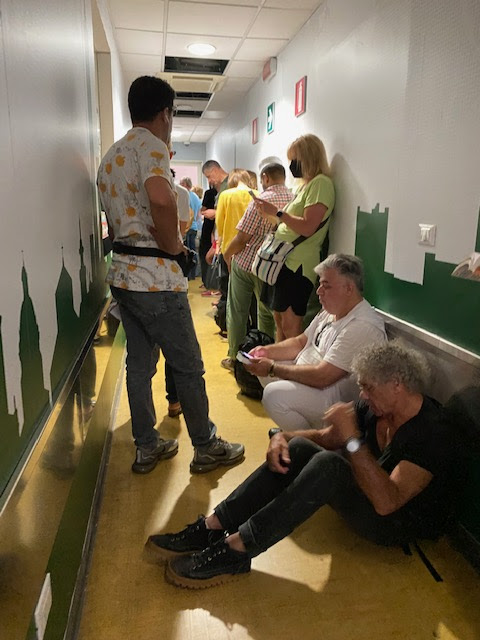
And so we journeyed back to the airport during the luggage room open hours that accommodated for a  two-hour Italian mid-afternoon coffee break. Not joking. We joined the back of a 25-person queue that moved at a glacial pace. Some people had received a call their luggage was there, some people had no clue where their luggage was. An American family in front of us flew Lufthansa the night before--the plane left without anyone's luggage and no one could tell them where any of it was. They were travelling down the country to visit children in Florence so they wouldn't even be in Bologna for long. When they eventually got to the front of the queue, they received no resolution. 

After 3-hours in the queue, we reached spitting distance of the front...half an hour before 'coffee break time.' Half an hour later, one overly loquacious Italian separated us from the front. The staff looked on miserably but didn't close the queue--in my bureaucracy-fuelled rage, I would have refused to move anyway. 

And finally, after a 30-minute taxi ride and 3.5 hours in a poorly ventilated, dimly lit corridor, me and old blue were reunited. 
In the grand scheme of travel drama, being temporarily parted with your luggage is not generally a big deal. It's happened to me several times before. But the school year was long, my sanity was at a very low ebb, the Heathrow graveyard photos haunted my already overactive imagination and Italian bureaucracy encouraged me to think the worst.
One crucial lesson learned here. Always pack a spare pair of pants in your carry on. We have reached the age of travel chaos. In fact, you might as well pack a few days' worth of clothes. Summer's later flight encouraged me to add snacks to that list as well. But that's a story for another day.