20 November 2013

The Angkor Temples--Angkor Wat

As part of my undergraduate studies, I spent a semester at Edinburgh University and took a class that explored the notion of 'the sublime'.  My professors connected it to a series of Victorian novels, landscapes and a general obsession with trying to understand that which could not be defined; I appreciated this nuance but didn't necessarily understand it. Not until Angkor Wat.

The Angkor temples cover nearly 400 square kilometers in Central Cambodia and were created between the 9th and 15th centuries.  There are over 37 temples, some huge, in this space. The site has been capital to the Khmer Empire at several points in history and has survived occupation, civil war and looting at various points in recent history.  

From Siem Reap, our tuk tuk driver picked us up and ferried us to the ticket station--a remote building some 10k away from the entrance.  We paid our one-day $14 fee and were given photo ID cards that we were required to procure at various points in our day.  Most people opt to spend 2-3 days wandering the temples but since time was of the essence, we crammed the 4 biggest temples into one day.  

First Stop Angkor Wat 
Angkor Wat, built between 1113-1150, is the largest temple of the Angkor complex and is considered the world's largest single religious monument.  From a distance it looms impressively and when you get closer it doesn't lose that appeal.  

Despite the 38-degree heat, the temples were teeming with tourists.  We crossed paths with people from all over the globe who followed us from place to place.  Fortunately, we managed to snap a few pictures that didn't show the hordes. 


12th century etchings 
Buddha 
 

 Embracing my inner Asian tourist 
High angle shot 


We spent a solid two and a half hours exploring before catching our tuk tuk to the next temple.  But over and over again, I couldn't shake the sensation of woah.  My brain did not comprehend what I was seeing.  I didn't, I don't understand how something so vast, so intricate could be built in a time before heavy machinery.  To me, Angkor Wat was a testament to the human spirit, an ode to the sublime. 

10 November 2013

Siem Reap

Our photos of the city of Siem Reap essentially involve food only.  There's a very good reason for this--we spent a bulk of our time there at the temples of Angkor Wat for which I've got something like 200 photos of.  But Siem Reap's definitely worth a mention.  

The translation of its name is 'Siam Defeated'; Cambodia's got a sad history particularly in the immediate past.  For centuries, animosity stood between the Siamese and Khmer people.  But during and immediately following the Vietnam War, sides were drawn and divisions were created between Vietnam, China and the US.  A civil war ensued, and the Khmer Rouge regime has now become known to be one of the most brutal in Cambodia's history.

Since these days, Siem Reap and Angkor Wat have bounced back.  Angkor Wat is Cambodia's biggest tourist attraction and more and more budget airlines are bringing their custom to this little nation.  Siem Reap is the feeder town for people to head to the ancient temples of Angkor and it does a good job at feeding, watering and adorning the tourists with various bits of tat and tack.  
the view of a bridge to one of the town's night markets 

There are at least four night markets in a short radius, a loud and brash road of bars, aptly named 'Pub Street' and a range of restaurants.  We found the most authentic looking which was filled with a range of Cambodia and Asian tourists called 'Stephen's BBQ'.  For the sum total of £8 ordered beer and the 'Khmer BBQ Special', a range of small plates of rice, noodles, meat and seafood that came with a tabletop grill.  
After a waiter pours in a small amount of boiling water, the goal is to place the lumpy chunk of lard on the top of the grill and let it lubricate (for lack of a better word) the metal surface.  Then you use chopsticks to place, flip and cook all the ingredients on the grill before placing them into a tiny little bowl and scooping them into your mouth.  

Another variation of this was at 'Master Suki Soup' restaurant where your table is adorned with a built-in electric stove top.  You point to ingredients you want in your soup--I opted for mushrooms, noodles and  morning glory (a vegetable I can assure you), whilst Paul opted for the 'Master Suki Chef Balls' (mostly for comic effect).  The waiter pours in a bunch of broth-like water, you add spices to your taste and then the trays of things and...voila, you have self-service-soup.  

Bless a country that appreciates soup as much as I do. 

Phnom Penh

After sleeping off the jet lag and exploring our first stop, we made arrangements to head to the majestic Angkor Wat in Cambodia via Phnom Penh.  Because I am a glutton for punishment and like arduous bus rides, we booked ourselves into a mini-bus from Ho Chi Minh to Phnom Penh before taking another arduous journey to Siem Reap the next day.  The journey was simple enough to arrange and we paid £10 each for a seat on the 'express' service.  Six hours and a border hop later, we arrived into sweltering Phnom Penh.  

Our first tuk-tuk ride through the city was a little overwhelming...
But we made our way to delightful accommodation recommended to us by Paul's co-worker.  If you find yourself at a loose end in Phnom Penh, may I recommend the Blue Lime?  We paid prices that will disappoint you if you ever try to book a hotel in the US, UK or anywhere else in the world ever again.  Four star accommodation was met with five star service; one of the concierge set us up with a friend of his in Siem Reap who became our tuk-tuk temple driver and tour guide for the following three days. 
 
Unfortunately, because our two-week trip was so quick, Phnom Penh acted a glorified rest-stop.  We couldn't fit in the historical bits we wanted and we couldn't avoid the throng of tourist restaurants, gift shops and other tacky venues.   
 
Fortunately, even in the tourist restaurants you can order a beer for $1.50 and receive a pitcher for exactly the same price. 
 
And we still found a few real gems like this! 
 
The National Museum of Cambodia 
The ascent to Buddha
 
Buddha 
Looking like a real tourist. 

Thus, our day in Phnom Penh ended.  We suited up for our next journey to Siem Reap and loaded our gear into the mini-bus.  We quickly learned that Cambodians use their horns to signal they're pissed off with the way the person in front of them is driving and they are therefore going to pass that person at top speeds on the opposite side of the road despite what oncoming traffic thinks that they're doing there. Amongst drivers that pissed our driver off was an entire convoy of google street map drivers.
If you happen to do a google maps street view search of the route from Phnom Penh to Siem Reap and you see a white van veering from side to side, I'm probably in it.

I think it's justifiable to say that the driving experience was terrifying. But we got to Siem Reap in one piece. And how worth it it was. 

Ho Chi Minh City

Ho Chi Minh City is a city of terrifying proportions.  Everywhere you look, everywhere you go, you're watching out to make sure motorbikes don't hit you. Road. Pavement. Shop. It does not matter.  They will find you and beep beep past you, just narrowly missing your foot, bag, boyfriend.  

And still, when you're a city dweller, you take these things to heart.  People don't have time to waste and there's a pragmatism to finding the fastest ways from point A to B.  

On our first day, I must admit, it did get the best of us.  But fortunately, Vietnam is also known for its strong, strong coffee and excellent cafe culture.  An hour into our first day's wandering, we took refuge into the Trung Nguyen Coffee Shop, Vietnam's answer to Starbucks Coffee.  Last decade, Vietnam flooded the market with robusta coffee and caused prices to crash worldwide.  Without going into too much detail about my Starbucks-employee-gained coffee education, robusta roasted coffee is a far inferior bean to its arabica cousin.  And the flooded market obviously caused problems for both the world economy and Vietnamese farmers.  

In practical terms though, it means that Vietnam has turned its coffee production and appreciation in on itself.  It improved its methods of roasting, cultivated their coffee establishments and celebrated home-grown establishments a-la Trung Nguyen.  

Upon arrival on one corner Trung Nguyen or another, we were greeted with delightful air conditioning, a 12-page menu (including a range of cakes) and a complimentary glass of something that tasted like soybean iced tea.  

From there, we had a delightful vantage point to watch the world of district 3 pass us by.  And what a world it was...
A organised person's worst nightmare
 
bamboo on a bicycle 

Fortified, we returned to our wanderings, never straying too far from our accommodation and taking right turns at red lights only.  I was heartened to learn that despite years of an awful 'American War', as the Vietnamese called it, the locals were not hostile to my American accent.  In all honesty, people generally ignored us as we went on our way from Communist tourist site to Communist tourist site.  

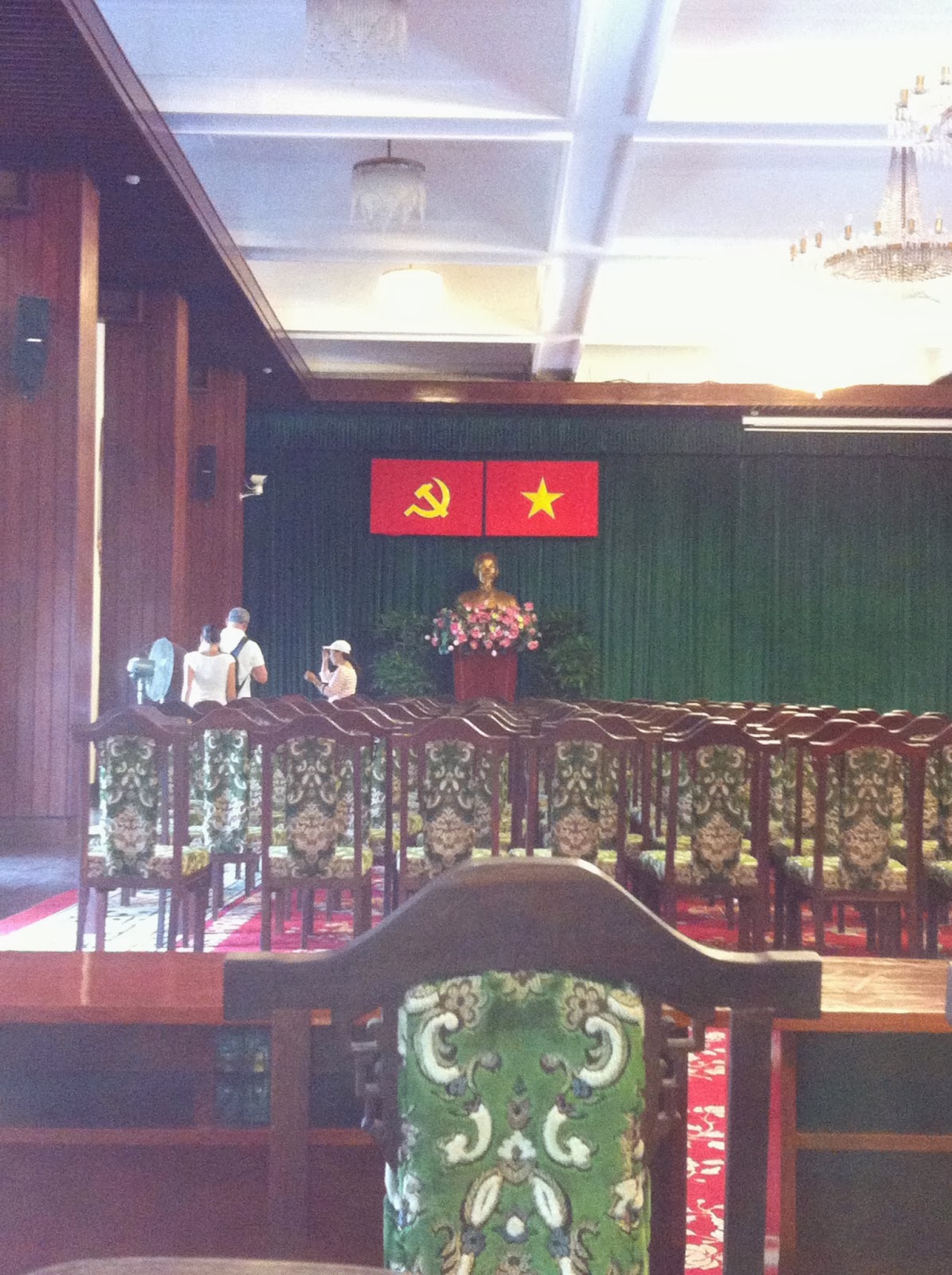
Reunification Palace, where Communist tanks triumphantly rolled into signaling an end to the war in 1975.  Not being alive at this point, I couldn't tell you much. 
Close up
Ho Chi Minh's podium of power.  The myriad Communist flags were a bit off-putting at this point, but you get used to them. 
The city's Catholic Cathedral, with birds--for effect, obviously
numbered trees in the park seem practical when you're meeting friends for a picnic 

From here, Paul and I got a bit more comfortable and made our first attempts at crossing the road on our own.  This feat should not be underestimated.  Step One: look for a gap. Just don't expect this gap to be bigger than a foot.  Step Two: Go. Just go.  Close your eyes and go.  Step Three: Whatever you do, do not hesitate.  Never. 

We were rewarded with sites like the market, one historic pagoda or another and some wonderful, wonderful roadside dining.
Jade Pagoda 


'Lucky' Turtles.  At the front gates of the pagoda, peddlers hawked their wares--you could purchase a turtle, write a message on it with wite-out (tip-ex for you British readers) and then release it into the pond of luckiness. 
 
A bell chiming, gongs gonging service like nothing I've ever seen before 

And our last stop of the day happened to be this delightful roadside restaurant.  Our self-given advice on choosing a restaurant was this: 1. avoid the places in the guide book 2. Find a place with lots of Vietnamese people siting outside 3. Streetside restaurants are even better.  This advice only failed us once and fortunately the experience left us only £1 out of pocket.  And neither of us left with food poisoning.  

It's hard to put into words the surreality of drinking beer and eating noodles whilst motorbikes go zoom-zooming past you.  Where drivers cook whilst driving and try to sell your their dried squid while you eat.  Where a man drives by with his 'disco bike' playing music and selling pirated cds.  Where women pass you selling lotto tickets, gum, cigarettes.
Where you find ice cream in the shape of a fish in the corner shop.  

Hail to southeastern Asian cities.  

9 November 2013

Summer 2013

We find ourselves in the midst of a November rain here in London and i've yet to blog the various post-Ghana adventures.  Work, as usual, gets in the way and I reach new levels of sleep-ridden apathy on Saturday mornings.  This doesn't stop the fact that: 1. I celebrated seven years in the UK on the 18th of September and 2. Paul and I spent two weeks in Vietnam and Cambodia at the end of August.

Our rough itinerary:

Ho Chi Minh City, Vietnam
Phnom Penh, Cambodia (via a six-hour mini-bus ride)
Siem Reap, Cambodia (via another six-hour mini-bus ride)
Hoi An, Vietnam (flight!)
Nha Trang, Vietnam (via sleeper bus--much more on this later)
Ho Chi Minh City, Vietnam (via very cheap internal flight)

Our journey began on a sunny Thursday evening and after flights from London to Dubai to Ho Chi Minh, an excruciating bureaucratic queue throughout the visa issuing office pre-passport control and a baggage drug screening, we were greeted/struck by a wave of hotly humid air.  And 3 million motorbikes.
We were warned, but not prepared, for this...

10 August 2013

Beautiful Uses of the English Language

It was everywhere!


The Peculiar International School 

Spotted at Nsaba Senior School 


What does this even mean? 

Is it ironic that I found an iron mark on my dresser? 


Look closely: 'touching our generation with the power of God.'


In the toilet of Chez Afrique 

9 August 2013

The End of Our Teaching


Today I found myself embroiled in a battle of the wills with a group of 35 maths teachers. Why anyone out me in front of a group of maths teachers is beyond me, but I delivered a session on Inclusion and Differentiation which involved rudimentary stick figure drawings and an extend Support: Challenge: Develop debate about the way to stop AIDS from spreading across Africa. 

My class humoured me before asking a series of progressively more challenging questions ending in: 'do you use the cane?' After swerving my way around positive behavior strategies I use instead, I was then given a round of applause. I cannot imagine getting a round of applause for doing a training session at home and I cannot imagine that a group of teachers forced to come in on their summer holidays in England would be anything except openly hostile.


And still, the teachers come in smiling, grateful to be in our sessions and open to listening and considering a series of provocative challenges that threaten to change the well-established environment in their classrooms. Challenges, that when imposed in England, caused widespread anger and debate. You want us to talk less? You want us to create completely independent learners? You want us to give up control? The teachers here might think we're crazy, but they handle it with true professionalism. They critique and ask questions, but that makes me think they might try some of the ideas. 

This will be difficult for teachers in a system where rote learning seems to be the government's educational policy at the moment. A more child centered approach was implemented in Accra three years ago, but it's yet to trickle this rural direction. Thus, students' books are filled with paragraphs copied from the board, exercises in recall and quizzes arbitrarily marked out of 5/10/20 depending on the day. This means students can tell you what iambic pentameter, similes and personification are, but they can't tell you why the writer uses them or what inferences we can make about the characters being written about.  

Change is in the cards though and the teachers are up for anything.  

I think some of this positivity comes down to the Agona Educational Team consisting of Mina, Mary and Reverend John who put on a rather long-winded but ceremonial opening event hosted in the presbyterian church just off campus.  We all attended on Monday morning and were reminded that: 1. we were on British time, not Ghanaian Time (more to our African colleagues); 2. We all needed to open our hearts and minds to progress: 3. We were on British time, not Ghanaian Time. So important it was mentioned twice.  

The team of administrators were a force to be reckoned with.  On a daily basis, Mina called non-attenders demanding to know where they were.  She also ensured our facilities were well-kept and our drink, snack preferences were to our liking.  She wandered, greeted, buzzed around to ensure the teachers were making the most of their sessions.  Mina need not worry; they were.  

In the end, it did feel like we made a bit of impact.  Closing evaluations revealed that this was the first Professional Development event many of the teachers had attended.  Unlike the teachers in Accra, they had limited access to training and INSET.  Our closing evaluations also revealed statements like: 'This was awesome', 'God Bless You' and 'We are truly grateful'.  

It's hard not to feel warm and fuzzy with feedback like that.