4 March 2015

The Chocolate Hills and other Surrealism

We were already quickly learning that things on our temporary island home worked differently to anywhere we'd ever been before.  The same went for a day tour we took, booked at the local tourist office.

The trip boasted a jam-packed itinerary: the Chocolate Hills (not actually chocolate), a visit to the tarsier sanctuary, a local cathedral.  What was less advertised were the ridiculous stops in between: to the butterfly garden; a river cruise; a swing across the river on a zipline; to the Bohol python's house--a name for both the gigantic snake and gigantic transvestite who drummed up business there.

What's more, we paid a flat rate for the first three stops.  At 400 pesos, it was hardly expensive.  But then at each successive stop you pay for the attraction.  If you don't want to go in, you wait at the side of the road as everyone else in the tour group shuffles in, out and back to the mini-bus.  The costs are nearly negligible.  But I have a slightly ashamed loathing of things that flutter and land in my face and the idea of a zipline in a very developing part of the world made me a little more than nervous.   As such, there was a lot of roadside sitting and waiting.

Stop One: The Chocolate Hills
 The Chocolate Hills are a series of nearly 1,300 verdant hills that dot the interior of Bohol's landscape. In the dry season, the grass turns brown and hence their name, Chocolate Hills. Winding staircases take tourists up close and personal.  There one can gain various perspectives of the reality of the hills.  Because, from an aerial vantage point they resemble boobs, endless boobs on the landscape for as far as the eye can see.
But they're important boobs.  The Philippines has declared them the 'third National Geological Monument', a surefire way to increase tourist revenue.  And the tourists flocked in to walk up the stairs, walk down the stairs and file back on the bus to the next stop on the campaign trail.
 
Stop Two: The Man-made Forest
From there, we made our way to the 'Man-made Forest', a fancy way, I think, of saying 'a forest of bamboo and other trees that was planted by people and therefore not naturally occurring'. The trees looked pretty real to me:
 The stop was less of a stop and more of a pull up to the side of the road, snap some photos and be on your way. We quickly parted with all things man-made and fluttered towards the butterflies. More side-of-the-road sitting. 

Stop Four: Bohol Tarsier Research and Development Center
From all the hype, this stop had promise.  Bohol is home to the tarsier, a teeny tiny carnivorous primate with dinner-plate sized eyes.  Pictures of the cutie adorned postcards and t-shirts island wide; they've become something of a national symbol. 
 The tarsier is a shy, noctural creature that struggles to live in captivity.  Rumour has it, when boxed into too-small spaces they cry listlessly, go on hunger strike and then throw themselves at the bars in attempt of suicide. A local man took pity on their plight and set up an outdoor facility--a sea of calm and quiet tucked faraway off the main road. There, these little recluses have space to run amongst the trees and be their tarsier selves.

Noises, sunlight and daytime are the tarsiers' biggest enemies.  Hence, a midday excursion to the Research Center found all the big-eyed buddies clinging to branches under the sanctuary's canopies. They hid:
I took pity on their state of wanting to be left alone.  In the midst of a good nap, I'd hardly like to be awoken to a snap-snap-snapping of annoying tourists.  We made our way through the gift shop, a mecca of all things tarsier before heading to our next stop.

Stop Five: The River Cruise and Zipline
We were fed lunch on our next stop, a beautiful ride on a covered pontoon down the Loboc river.  Along the way, government commissioned 'folk' acts stood at platforms waiting to perform to the passing tourists.  I was a bit confused by this--namely by school-aged girls who looked like they should be at school but instead performed traditional songs and dances.
Towards the end of the river, danced a zipline where occasionally screaming bodies flew across.  Our boat ride done, we made for the launch point of said zipping.  I, again, opted for not zipping but enjoyed watching my bus mates, one with the worst case of Resting Bitch Face I've ever seen, scream and flail:
And because I live in Asia, I tried to work the finer points of my Christmas white elephant gift, the selfie stick! 
Maybe next time, the stick won't be in the picture.

Stop Six: The Bohol Python
I almost didn't go into this impromptu side-of-the-road zoo but I'm rather glad I did.  Inside, common pigeons strutted themselves as exotic birds, photo opportunities abounded and I squared off with a 30-foot, 400-lb python. We also caught the tail end of the cross dressing Filipino who was entertaining/terrifying a group of local travelers.  The dress, boa and red lipstick didi little to hide his sizably muscled thighs.  But when in Bohol...  
Our 30-minutes was a delightful experience in sensory overload.
Our journey ended on the steps of the cathedral, only the journey took so long that the cathedral was closed.  So we crossed the street to capture one final breathtaking view before heading back to our starting point.
Weirdest tour ever. 

2 March 2015

Bohol

Our first stop on the epic Philippine tour took us to the island of Bohol, smack in the middle of the Central Visayas region of islands.  As far as Philippine islands go, Bohol's a rather large one; in fact, it's the tenth biggest of the nation.

In a theme that would continually repeated itself over the course of the trip, we checked into a mediocre accommodation in Panglao, on the far side of the island. It smelled a bit like rotten eggs but that's what you get when you travel to beachy nations at high season.

For context, however:
 
No complaints. So the beach was a beach, small and sandy. It didn't matter; at 27 degrees celsius, I wasn't at work.
 
 I think, perhaps more exciting in our wanders was the food situation. From all angles there was something to delight at. Take, for instance, seasonal exotic fruit. Bananas and mangos:
 Mangosteen (thank goodness for youtube 'how to peel fruit' tutorials):
Buzz Cafe and the Bohol Bee Farm, an organic restaurant that's sourced from its organic farm. They make everything from butter to honey to ice cream in uniquely Filipino flavours including something called Mallingay, a herb that tastes suspiciously like garlic on its most potent day: 
 Durian; Mallingay (if garlicky ice cream's your thing); Pandan; Peanut kisses:
 And then something truly magical happened. I encountered the world's best fish burger. World's best. Grilled on a real grill. On the beach. In front of me. This is what the world's best fish burger looks like; remember it. Find it if you find yourself in Bohol:
Most of our little section of the island focused around the little beach but on our way back we glimpsed into the Catholic world that is these islands. Outdoor church is perhaps something I could get behind...

View From Manila Airport

Our Chinese New Year holiday to the Philippines was one part stunning beauty, three parts ridiculous experience. Pythons, food poisoning, flight delays all featured.  There was ice cream and beaches too but that's kind of what you'd expect to be on holiday to an archipelago of over 7,000 islands.
And I don't want to speak poorly of the Philippines because the people, the hospitality were second to none.  They would have laid down their metaphorical carpets to ensure you had a good time, an enjoyable stay.   Stepping off the plane from China, we noticed a perceptible shift.  People were kind; they smiled and said hello;  English was universally spoken and understood.  These things were very welcome. And yet.

I guess after travels through Thailand and Vietnam, I thought I had Asian travel just about sussed.  But then you fly into Manila, with its millions of people crammed into a small space and you change your tune.  I mean, the chaos is the same.  But the infrastructure is so, so different.  The little we saw of Manila, between airport and accommodation was nothing to write home about.  In its fairness, most spaces on the outskirts of a city are not.  But was did strike me, was the US aid money floating around the myriad building enterprises, roads, shopping malls, you name it.   With a rising power like China on the doorstep, the Philippines is ideally placed to be a great ally to the US; what opportunistic friends the American government is.

Another difference that struck me was religion.  The Philippines is the second biggest Catholic country in the world.  If you sit down with a map of Asia, you will understand why that's so strange--it's surrounded by: China and its 1.2 billion 'officially atheist' population; Indonesia, the most populous Muslim country in the world; Vietnam, Thailand, Laos, et al--home of a smattering of 'smaller' religions--Taoist, Buddhist, Shinto.  Where Thailand was filled with stunning temples, the Philippines paid homage to the Pope and his recent visit.  Churches, both grand and tiny, dotted each island.

But I digress.

Island 'Hopping'
After a flight into Manila and a short sleep, we made our way back to the airport to catch a flight to the island of Bohol.  Easier said than done--Manila airport has four terminals, none of which are connected to one another.  To go from one terminal to another involves a taxi and twenty minutes, depending on the traffic.  We flew into brand-new terminal three and out of tiny terminal four--a glorified sandwich box for which you must pay a terminal fee to 'use'.  There's hardly enough space for everyone indoors so a restaurant and waiting area exist outside--there you can smoke, watch the planes land nearly touching them and then have your meal.  Fortunately, we arrived two hours for a flight that was inevitably one-hour delayed to enjoy these amenities.

The box of a pre-gateside waiting area (note man with cup-a-noodle, one of Asia's greatest inventions):
Unlike Vietnam and Thailand, flights were a bit of a pain to sort.  Not in their price (cheap) or their frequency (often).  What presented challenges was the sojourn back to Manila every time we wanted to transfer islands.  This makes sense if you're from the Philippines--lots of people go to Manila for work and then make their way back to family on various islands.  Most Filipinos have no need or desire to do island-to-island flights.

For tourists, this is annoying.  Over the course of our two-week stay, we flew to Bohol and then back to Manila, transferred terminals, flew to Palawan, back to Manila, transferred terminals and then back to Shanghai.  Between flight delays and connection transfers, we spent nearly two whole days at the airport.

So maybe my 'and yet' feeling stems from the fact that, despite two weeks in this island paradise, I don't feel like I even scratched the surface.  Unless you count an intimate knowledge of the airport.

7 February 2015

All Hail to the Dumpling

Shanghai is a city known for its dumplings and really, what's there not to love about a dumpling?  Steamed, fried, gooey on the inside, some filled with vegetables, some with soup.  They're a treat.

Xiaolongbao
Xiaolongbao are a particular Shanghai speciality.  They're small dumplings filled with a gooey vegetable/pork/prawn concoction, depending on your preferences, and then filled with a soupy broth.  To eat, bite a little hole at the top, dump the soup into your Chinese spoon and slurp.  Delight.  

The ones above are buns filled with soup, not dumplings, but follow a similar pattern.  Gimmicky, but in the middle of Yuyuan Garden and Shanghai's most famous dumpling institution, Nan Xiang Xiaolong Mantou, we didn't expect any less.  The outside takeaway window was crammed with Chinese tourists but the restaurant had an abundance of tables.  Prices were Shanghai middle class--we ate a lot and paid in the 300 yuan range.  Having since been to Yang's Dumplings, a fast food institution dotted across the city, I can attest to the expensiveness of our little tourist haven.  
But it was the festive thing to do.  With one week to go until the ushering in of the Year of the Sheep/Goat (the character is the same for both in Mandarin), the lanterns are out and the mood is festive.   This is the Chinese equivalent to Christmas, with all its requisite sales, shopping and frenetic movements.  As an international school teacher, I get both holidays--Christmas and CNY, five weeks apart, win!  

4 February 2015

Take My Breath Away

Everyone warned me that the pollution would be a constant fug of disappointment in the Shanghai landscape.  Up until January, that was a pretty big overstatement.

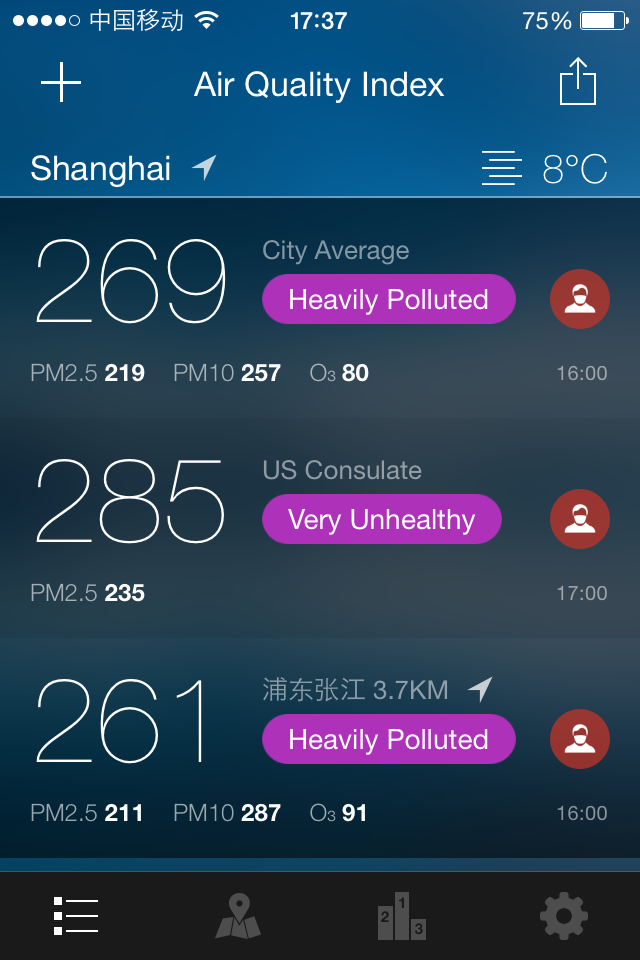
But with the upcoming Chinese New Year holidays and factories working overtime to produce gifts, biscuits, tat in all shades of red, all that swiftly changed.  Pollution levels are measured all across the city on the hour and flashed through satellites to smart phoned denizens of this great metropolis.

Based on these readings, days are RAGged (for my non-teacher friends that means Red, Amber and Greened) to suggest how likely it is that the air might kill you.  As you would expect, the Chinese government takes a relatively liberal stance on what 'good' air means.  As you would expect, the American government likes to throw environmental health tantrums and so much as a burplet from a factory sets the whole scale on meltdown.

The big number is called the 'AQI' or 'Air Quality Index'.  According to the US scale: 0-50=good; 51-100=moderate; 101-150=unhealthy for sensitive groups; 151-200=unhealthy for everyone.  Beyond this=wait for the apocalypse.
And that's not even the scary part.  Because the real number to watch here is the PM2.5 particulate.  This reading refers to particles in the air smaller than 2.5 micrometers which are particularly dangerous because they like to hang out in the gas exchange part of the human lung.  Sometimes these particles find homes in other organs or arteries and you've got some serious trouble to the tune of pulmonary disease or cancer (with long-term exposure).  The Chinese government suggests that a reading anywhere between 0-35 is 'good' and green.  The American government's green reading hovers between 0-12.  A US red reading hovers between 55-150.  Today, we're actually on something beyond red, called 'hazardous', something to which both the US and China agree with.  

Last Sunday, the reading toppled 418.

I've taken to doing as the Chinese do.  This is my PM2.5 mask:
It comes with a changeable filter that i've been assured 'most likely doesn't work.'  I've just managed to shake a pollution-started cold that's lasted nearly two weeks; thus, i'm desperate. Plus, a little placebo never did any harm.  

Masked up to his eyeballs, Paul has taken to screaming 'I KILLED THE BATMAN!' at the top of his lungs across the flat.  I guess we've all got our ways of coping. 

1 February 2015

All of a Sudden

It became February.  Home, the Christmas holidays, the month of January are things of the past.  January's generally a fickle mistress but I somehow looked up, blinked and it was gone. With two weeks to go until Chinese New Year and a subsequent two-week holiday, I reckon February is going to follow suit.

In minor news, Paul arrived! In one piece and only minimally shell shocked.  His luggage on the other hand, did not.  Stuck in Helsinki, of all places.  Would you believe it?
His adjustment to this crazy Chinese life has been remarkably underwhelming.  Despite puppy dog eyes when I stuck him in a cab on his first day, he's taking it all in stride.  And by 'it' I mean: armpits in the face on the rush hour metro; finding ayi Sunny (our cleaner!) wearing my slippers whilst doing the dusting; navigating the unsavory Carrefour crowd with his urbane London attitude: 'basically Jen, you've got to put your head down, look for the gap that doesn't exist and then hit anyone in your way who doesn't move.'  Ironically, he hates cab drivers who employ the exact same principles.

With the arrival of my directionally challenged half, we've taken to wandering the streets of Shanghai.  From Xintiandi to Dongtai Road Antiques Market to our local wet market,  I think i've seen more of Shanghai in January than I did in my first five months:
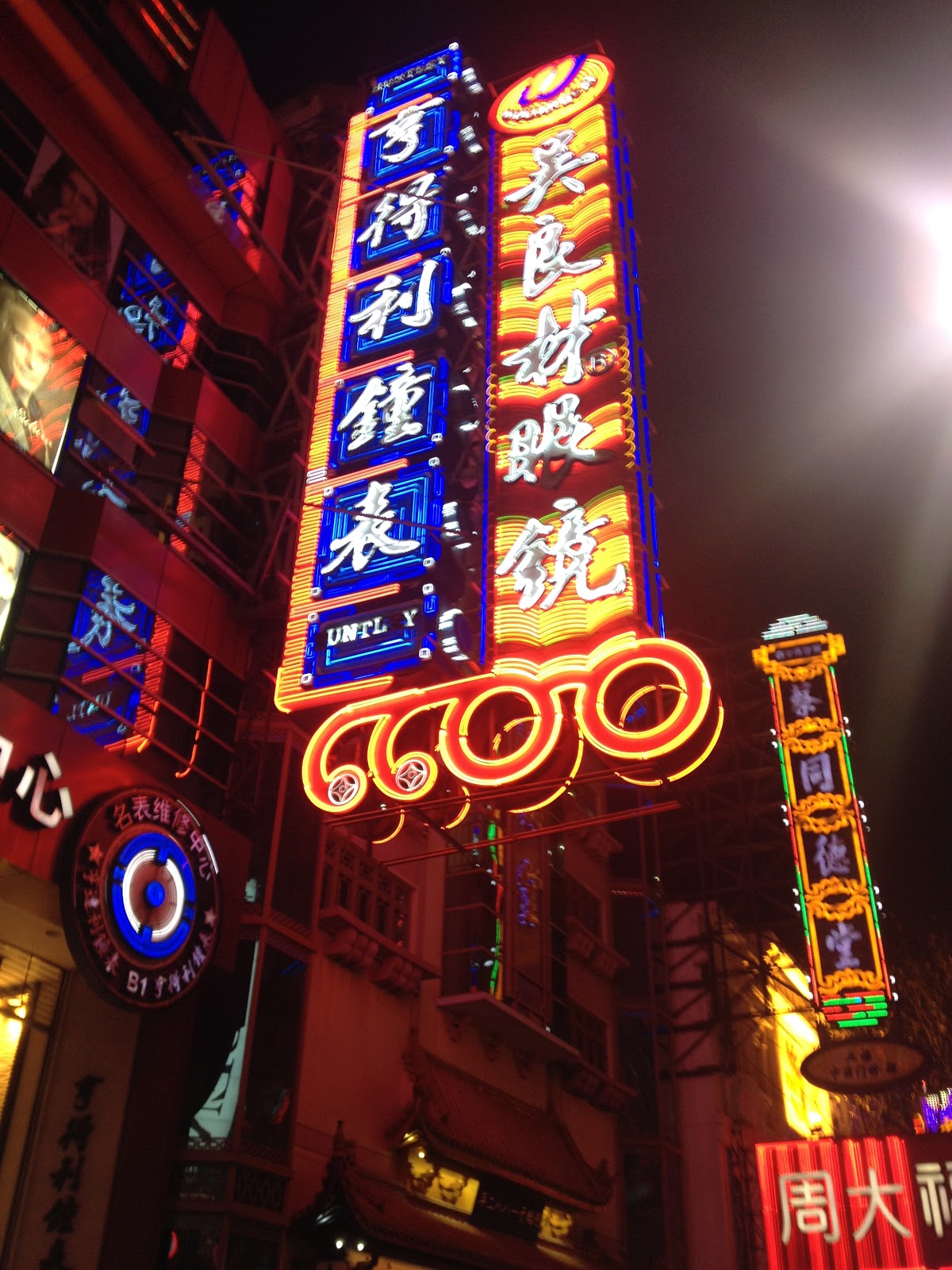
 The bright lights of Nanjing Road East
 
Dongtai Road Market is a glorified street of other peoples' junk.  In London, the merchandise would cost four times the price and be full of pretentious antique hunters donning posh accents.  Here, sadly, the city has the Market on the demolition chopping block.  The price of urban progress is almost always gentrification and Shanghai has a quick, fierce way of employing these tactics--one week a street, homes, markets are there.  The next, you return, and they're gone.  
Word on the street (literally) is that the market's time has come, that it's going to be relocated to an indoor venue.  Somehow it's not quite the same.  
 
 Because buying a tuba off the side of the road has its charms:
 It's also been a cultural month here in Shangers.  The beauty of working at a school where people want to do things is that people want to plan things.  On these coattails I've snagged tickets to Riverdance, an eat-way-too-much Sunday brunch and a VIP experience to see Michael Buble, the man, the myth, the Canadian legend.  Paul swooned.  I am grateful for lovely students and their lovely parents who manage arenas and give free tickets:
This place is growing on me.

19 December 2014

Adaptation

One of the many upsides of working in a school all the way across the world is the holiday time.  Schools compensate for the distance by giving you longer Christmas holidays—ones where you can travel home and deal with the jet lag.  And oh, the jet lag. 

This time around, I’ve got three weeks in Michigan.  As such, I find myself in a new coffee shop.  This time an independent branch in the downtown of my hometown, recently voted America’s 9th most livable ‘city’ by Money Magazine.   Because I’m trying to keep my acerbic nature in check, I’ll choose not to comment on this.  What I will say is, that with three weeks here, I’m trying to make the most of the Midwest bubble.

 I’ve already been to the orchestra—The DSO put on a remarkable performance of ‘Home Alone.’  With the big screen down, and the score cut from the film, the orchestra and choir played the backing music to the film along with a cheery number or two at the end.  It was beautiful.

On Sunday, the Avila women head to see the Moscow Ballet’s version of the Nutcracker.  And the rest of the three weeks will be consumed with yoga classes (some wanky, some okay), dinner with various friends, a Red Wings game and a classy NYE party in Downtown Detroit.   As I’ve been told by various friends and acquaintances, Detroit is ‘up and coming’.   The up will probably take years but I hope it gets there eventually.

Naturally, this is a good time to reflect on the term.  And if I journey back to my October post about adaptation, I am happy to report that I feel, in fact, adapted to life in China.  I mean, it’s crazy and ridiculous and completely unpredictable: 14 weeks of Mandarin lessons and I can just about say my address and the date; I’ve bought a scooter from a friend who’s now left; I’m no longer surprised by the things that anyone does.  I think I’m desensitised from the weird.

And work is remarkably okay.  I had a long time to ponder this on the 13-hour flight home.  In comparison to how exhausted I would have been on any London flight back to the US, the only signs of exhaustion I could feel were physical.  The mental exhaustion I have experienced in the last six years of my old job was curiously absent.   And then I had a think: At no point in this year have I felt that I cannot breathe, that I am struggling to keep my head above water, that I missed the scrutiny and constant poke-poke-poking of the British state school system.  I hope I do not regret writing this.  But it turns out that I, in fact, have a degree of work-life balance.

What a revelation.

It’s prompted me to really consider my options upon return to London.  I like the busy but not stressed out to the point of rage, person I have become this term. 


With that in mind, from one bubble to another, Merry Christmas.